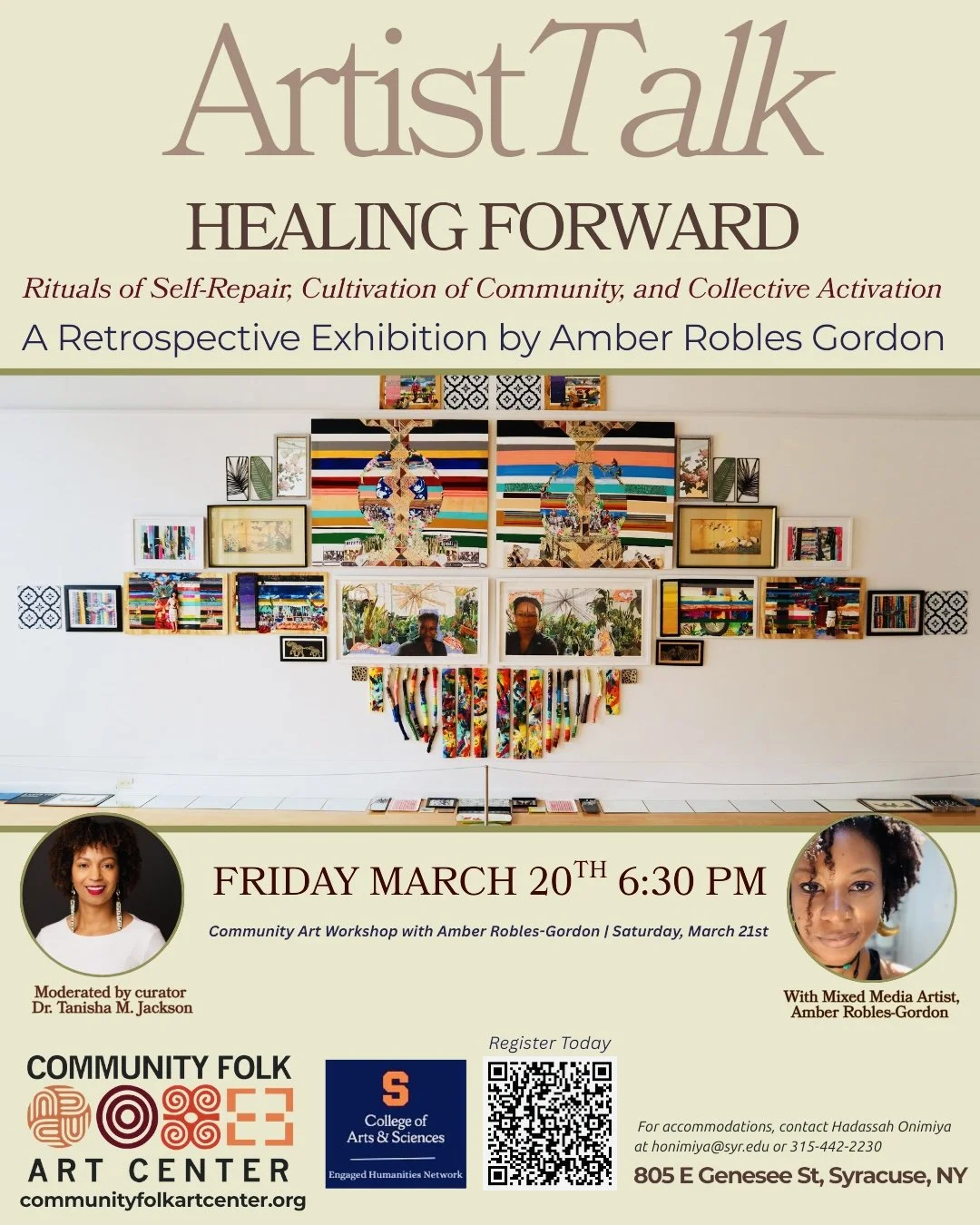
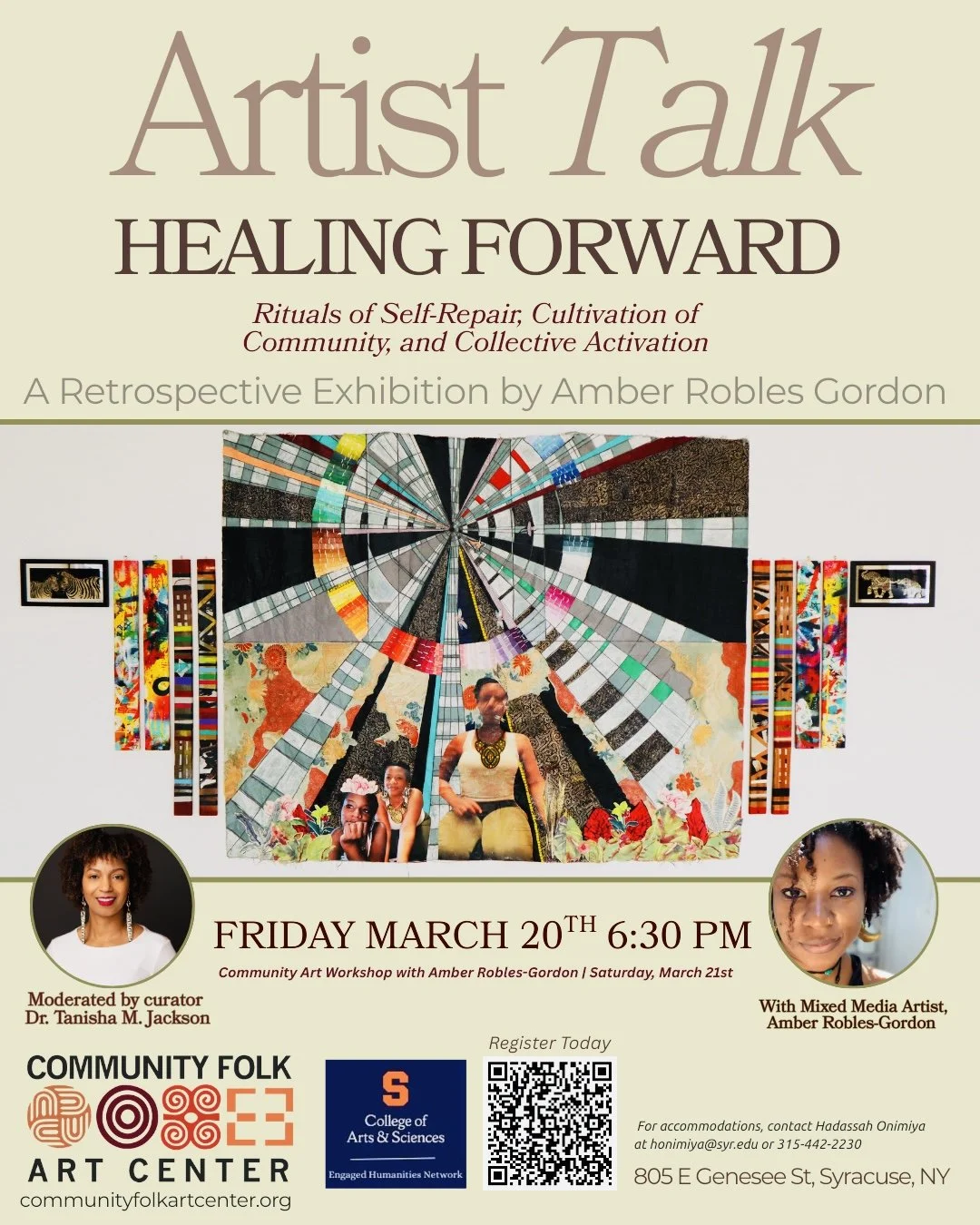
Healing Forward: Rituals of Self-Repair, Cultivation of Community, and Collective Activation
Retrospective Exhibition, Mixed Media Installation, 2026
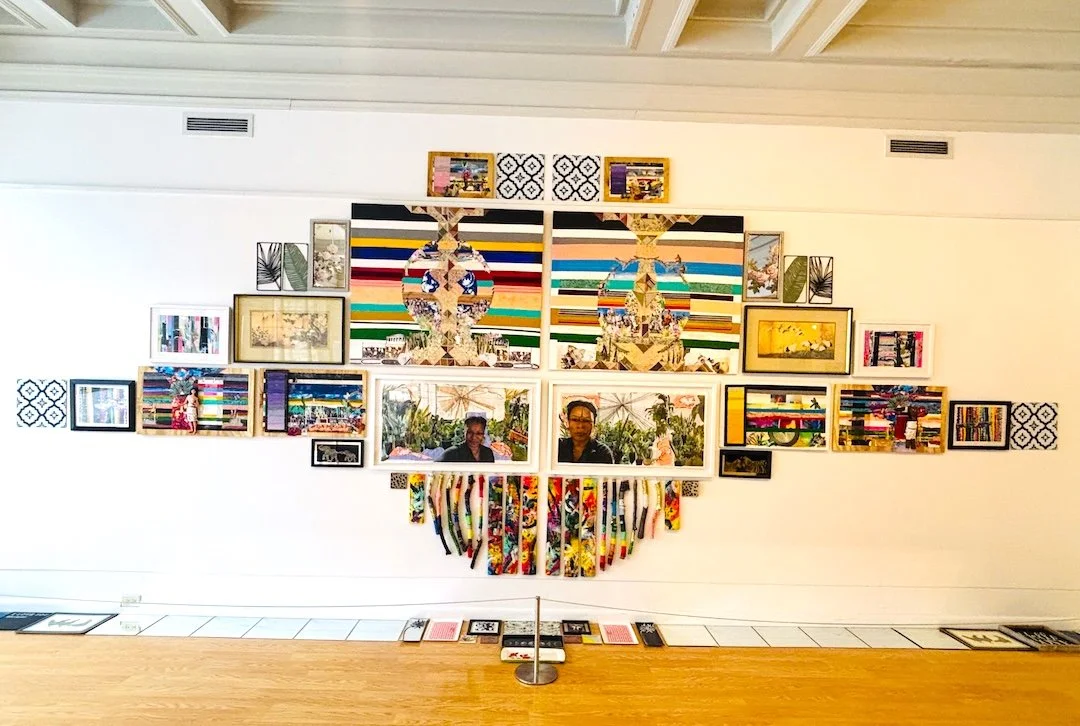
1. Yo, tú, Nosotros, creamos naciones, a través del amor, la verdad y la reflexión ( I, You, We Create Nations, Through Love, Truth, and Reflection), Mixed Media Installation, Community Folk Art Center, Syracuse University, Syracuse, New York, 2026
Healing Forward: Rituals of Self-Repair, Cultivation of Community, and Collective Activation
Retrospective by Amber Robles-Gordon
Exhibition Dates: February 9 - April 30, 2026
Location: Community Folk Art Center, Syracuse University, Syracuse, NY
Artist Talk: March 20, 2026 at 6:30 pm
Talking Stick Workshop: March 21, 2026 (Register for the workshop)
Healing Forward: Rituals of Self-Repair, Cultivation of Community, and Collective Activation, is a retrospective exhibition that traces the throughline of healing—personal, communal, spiritual, and ecological—across the artistic career of Amber Robles-Gordon. Bringing together installations, quilts, assemblages, and collages created over more than a decade, the exhibition reveals how healing has functioned not only as a thematic concern, but as a methodology and ethical framework within the artist’s practice.
As a focal aspect of this exhibition Robles-Gordon creates installations that build upon history, personal and ancestral memory and Afro-futurism to establish bird and totemic like data transference structures. Her installation formula is grounded in visual and/or asymmetrical balance. Each installation centralizes a large quilt. Which represents the body of the bird. The remaining medium to smaller artworks are arranged in pairs. One for the left side and its pair on the right side to create the wings. Ultimately, manifesting transference mechanisms in an asymmetrical arrayment of aesthetic and didactic messaging.
Robles-Gordon’s work has long been rooted in self-awareness, reflection, and repair—of the self, of collective memory, and of the environments we inhabit. Drawing from Afro-Caribbean spiritual traditions, decolonial histories, feminist thought, and ecological consciousness, her artworks operate as sites of reckoning and renewal. They ask viewers to confront inherited systems of harm while offering space for breath, ritual, protection, and transformation. The exhibition is organized into three interrelated sections, each articulating a distinct yet overlapping mode of healing and awareness.
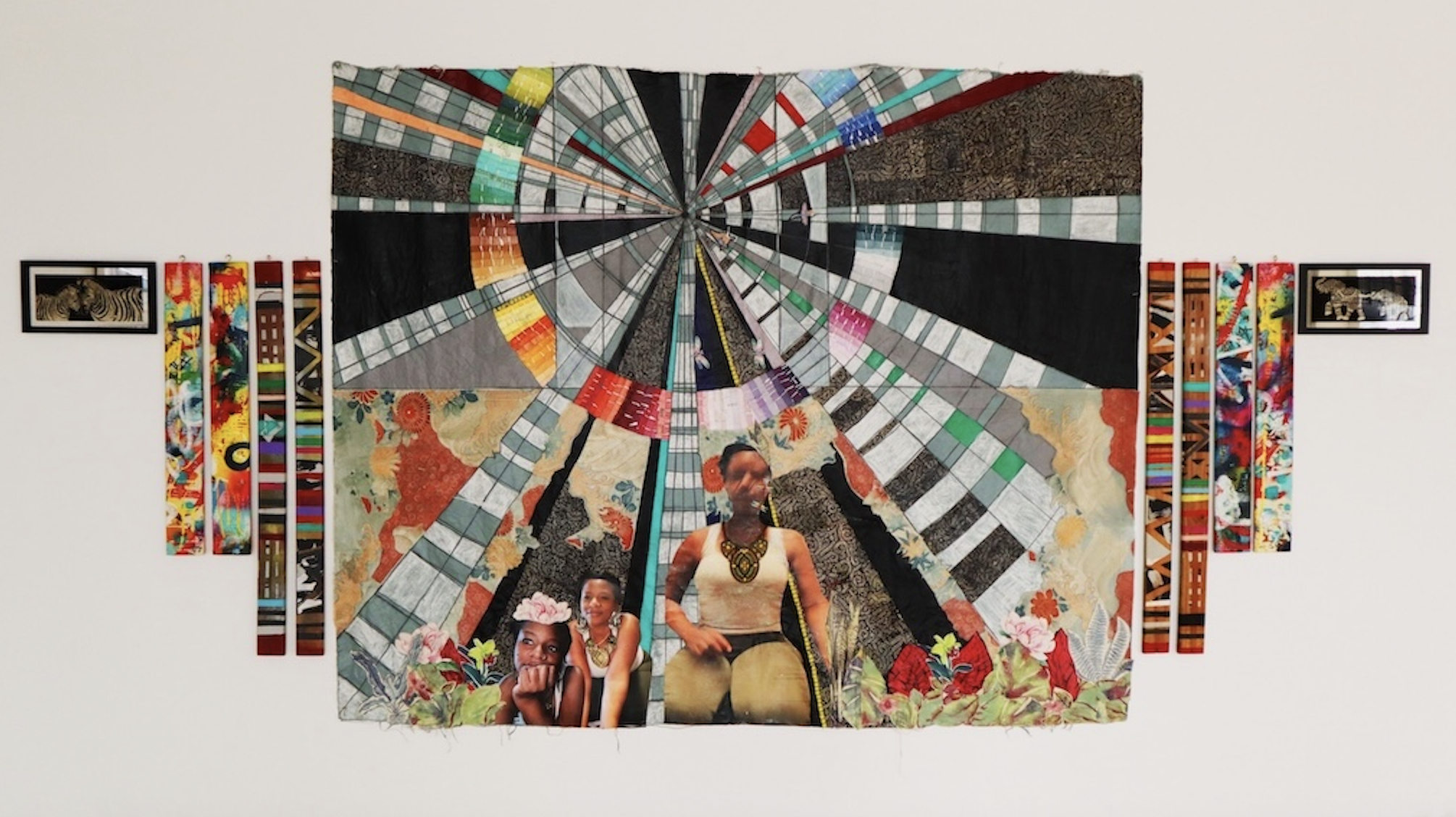
2. Soy luz, amor y frecuencia amplificada (I am light, love y frequency amplified) Mixed Media Installation, 2026
I. Reflections of Universal and Societal Healing
This section foregrounds Robles-Gordon’s engagement with collective trauma, historical rupture, and the interdependence of liberation struggles. Works such as Sacred CoEvolution: Undoing the Enchainment of Being(s) and Successions: Traversing U.S. Colonialism examine how colonial violence, racialized power structures, and ecological exploitation remain embedded in contemporary life. Through layered materials, symbolic forms, and spiritual cosmologies, these works insist that healing must be collective, relational, and accountable. Revolution: Is Dawning Because Our Liberation Will Always Be Bound Together further emphasizes solidarity, resistance, and the necessity of communal repair.

3, Despertando lo Matrilineal, Llamando a todos los puntos cardinales las Direcciones. Y la Gimnasia Matemática de la Morenitud y la Negritud (Awakening the Matrilineal, Calling all Directions. And the Mathematical Gymnastics of Brownness and Blackness), Mixed Media Installation, 2026
II. Healing Through Objects and the Environment
Here, healing emerges through material intimacy and spatial intervention. Installations such as Casting and Protection Work, Place of Breath and Birth, and In Tribute to Love, Nature, and Friendship activate objects, textiles, and natural elements as carriers of memory, care, and protection. These works reflect the artist’s belief that environments—both built and natural—hold emotional and spiritual residue, and that art can recalibrate these spaces toward balance, safety, and restoration. Viewers are invited to move through, around, and within these works, encountering healing as a physical and sensory experience.
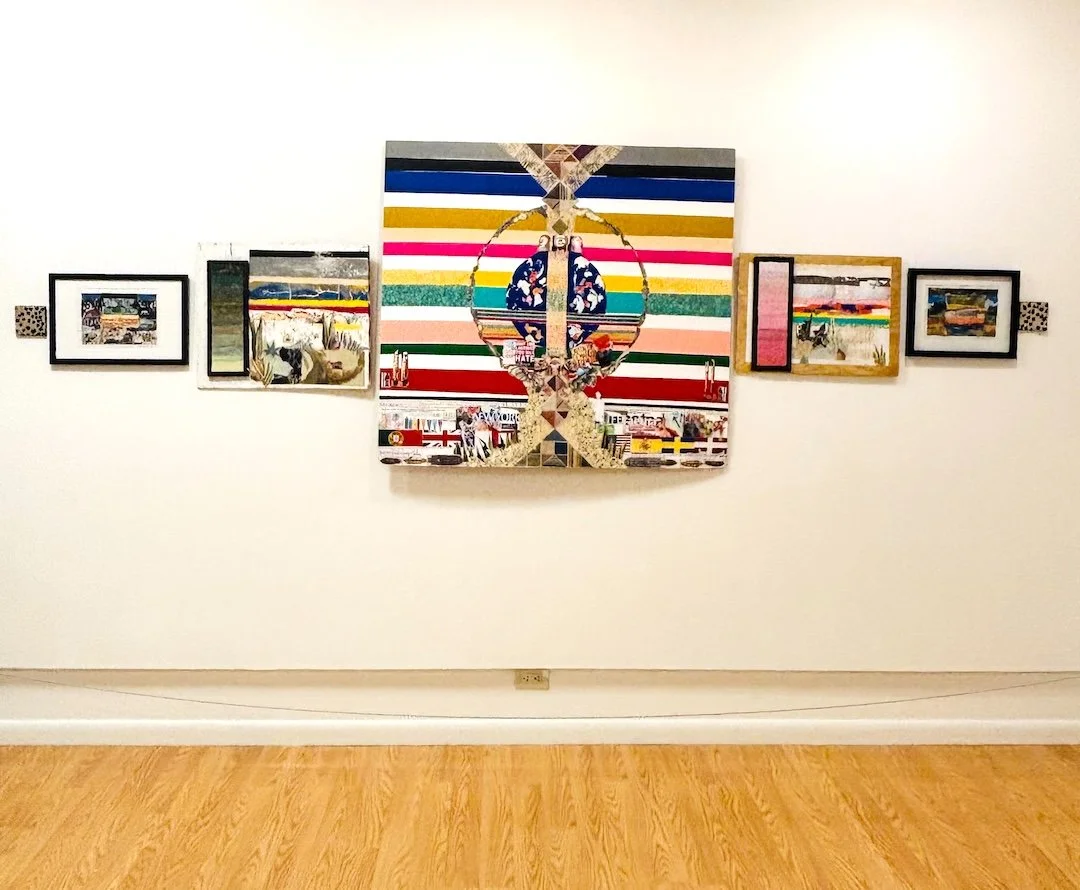
4. Mitigación del racism (Mitigation of Racism), 2 Mixed Media Installation, 2026
III. Healing Through Belief, Practice, and Activation
The final section centers ritual, spirituality, and embodied action as tools for survival and transformation. At the Altar: Dance of the Serpents and Above All You Must Not Play at God draw directly from ceremonial structures, ancestral knowledge, and sacred symbolism. These works operate as altars, thresholds, and invitations—asking viewers to consider belief not as abstraction, but as an active practice capable of generating protection, empowerment, and agency.
Collectively, Healing Forward positions Amber Robles-Gordon’s practice as an evolving archive of healing strategies—one that moves from introspection to communal activation. The retrospective affirms that healing is neither linear nor passive, but a continual process of reflection, confrontation, and collective care. In doing so, the exhibition invites audiences to consider their own roles within systems of harm and repair, and to imagine healing not only as recovery, but as a radical, forward-moving force.
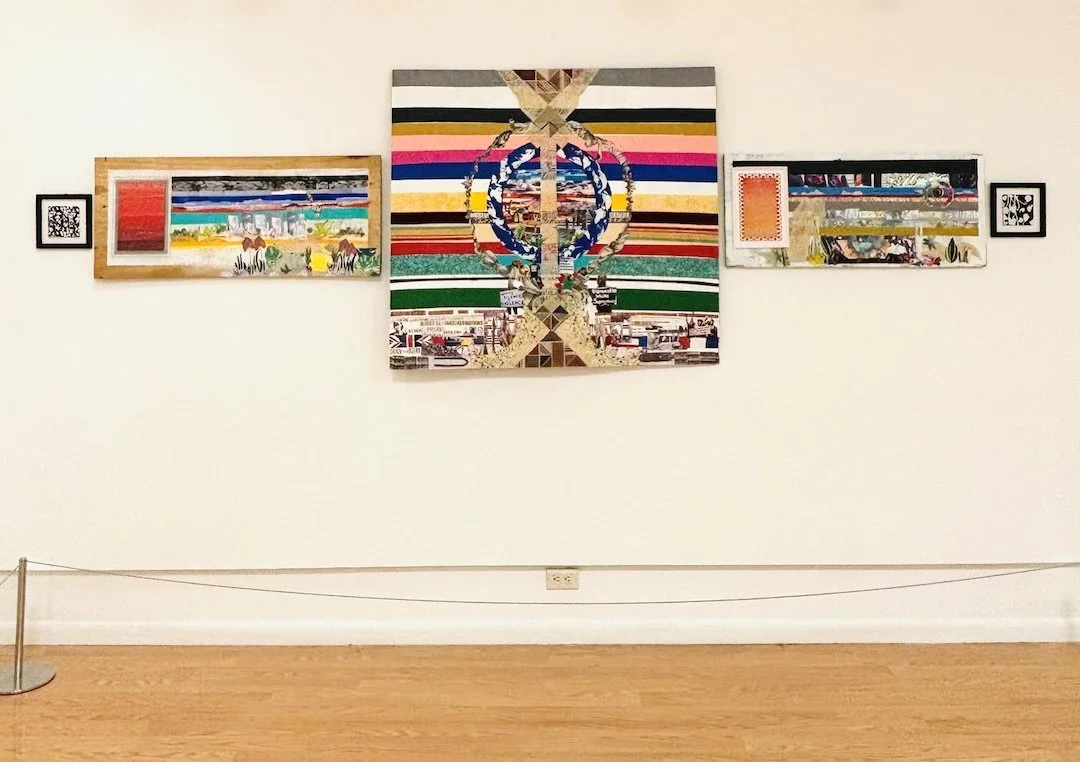
5. Lo que merecemos y se nos debe: Reparación, Restauración y Posibilidades Infinitas (What we are deserving and owed: Reparation, Restoration and Infinite Possibilities), Mixed Media Installation, 2026
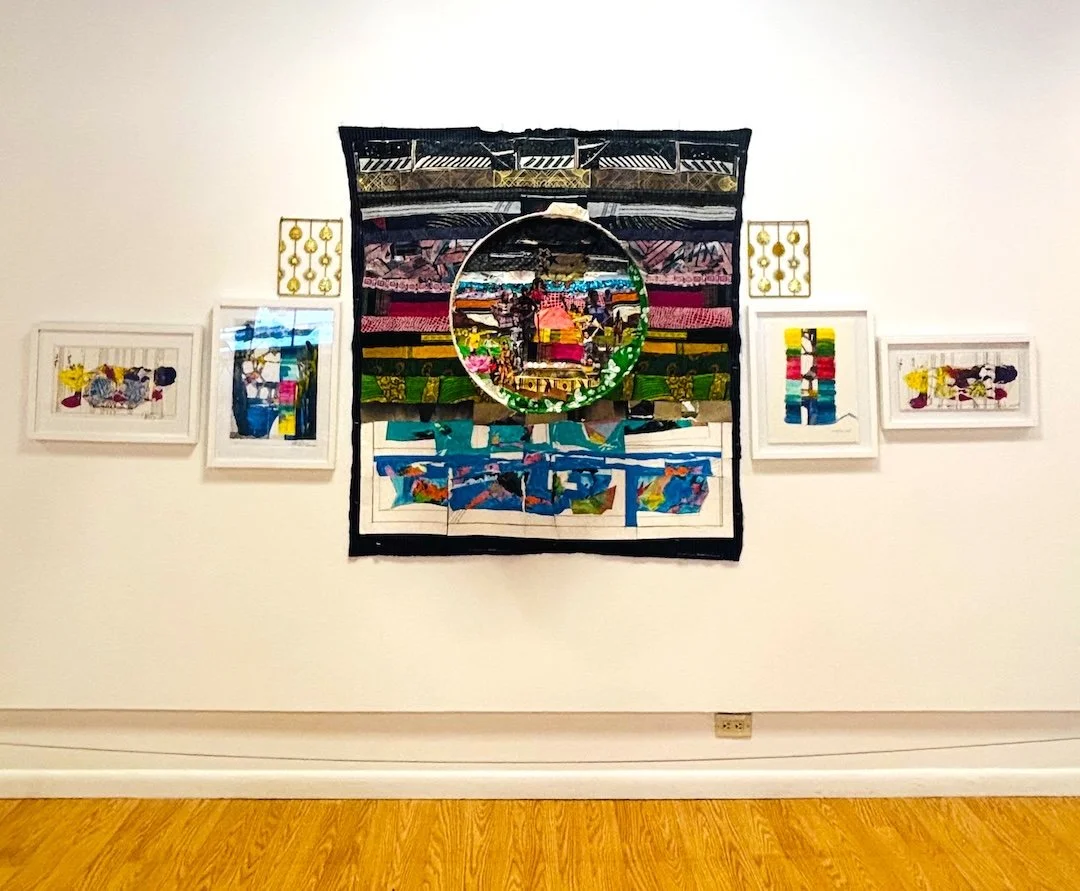
6. Anatomía del cuerpo infinito (Infinite Body Anatomy), Mixed Media Installation, Mixed Media Installation, 2026
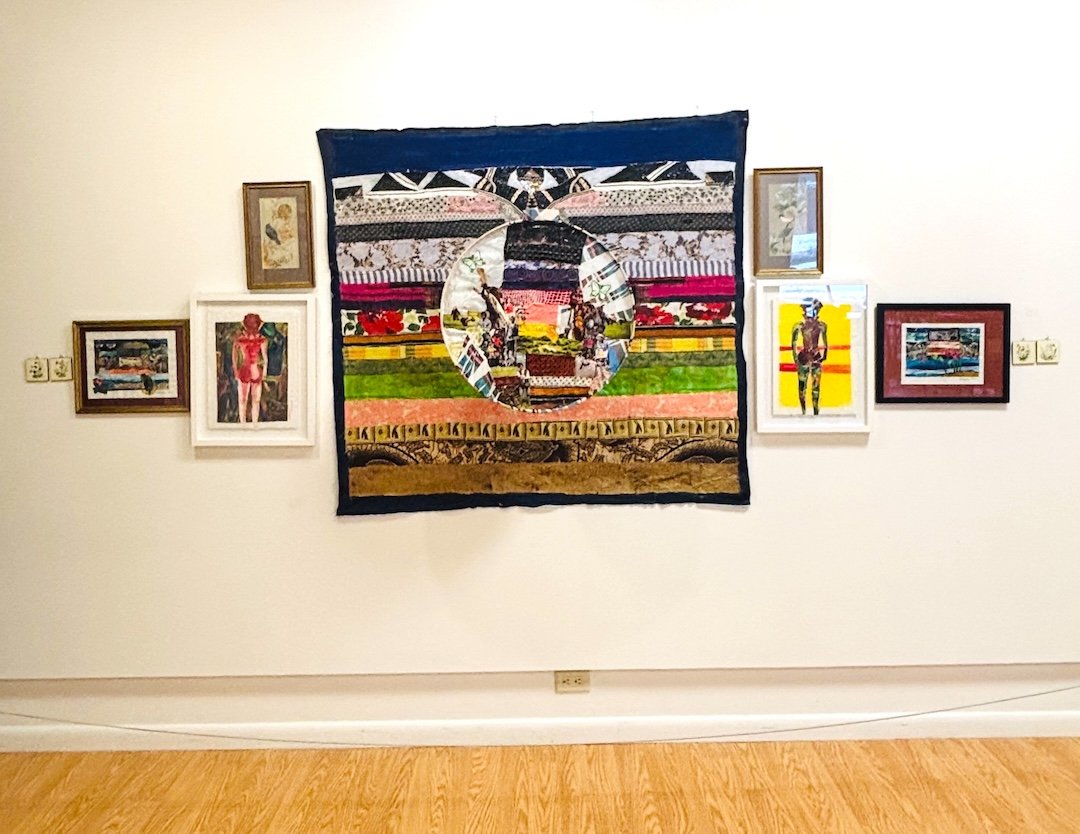
7. Administración divina de la tierra, el cuerpo y la mente. (Divine stewardship of land, body and mind.) Mixed Media Installation, 2026
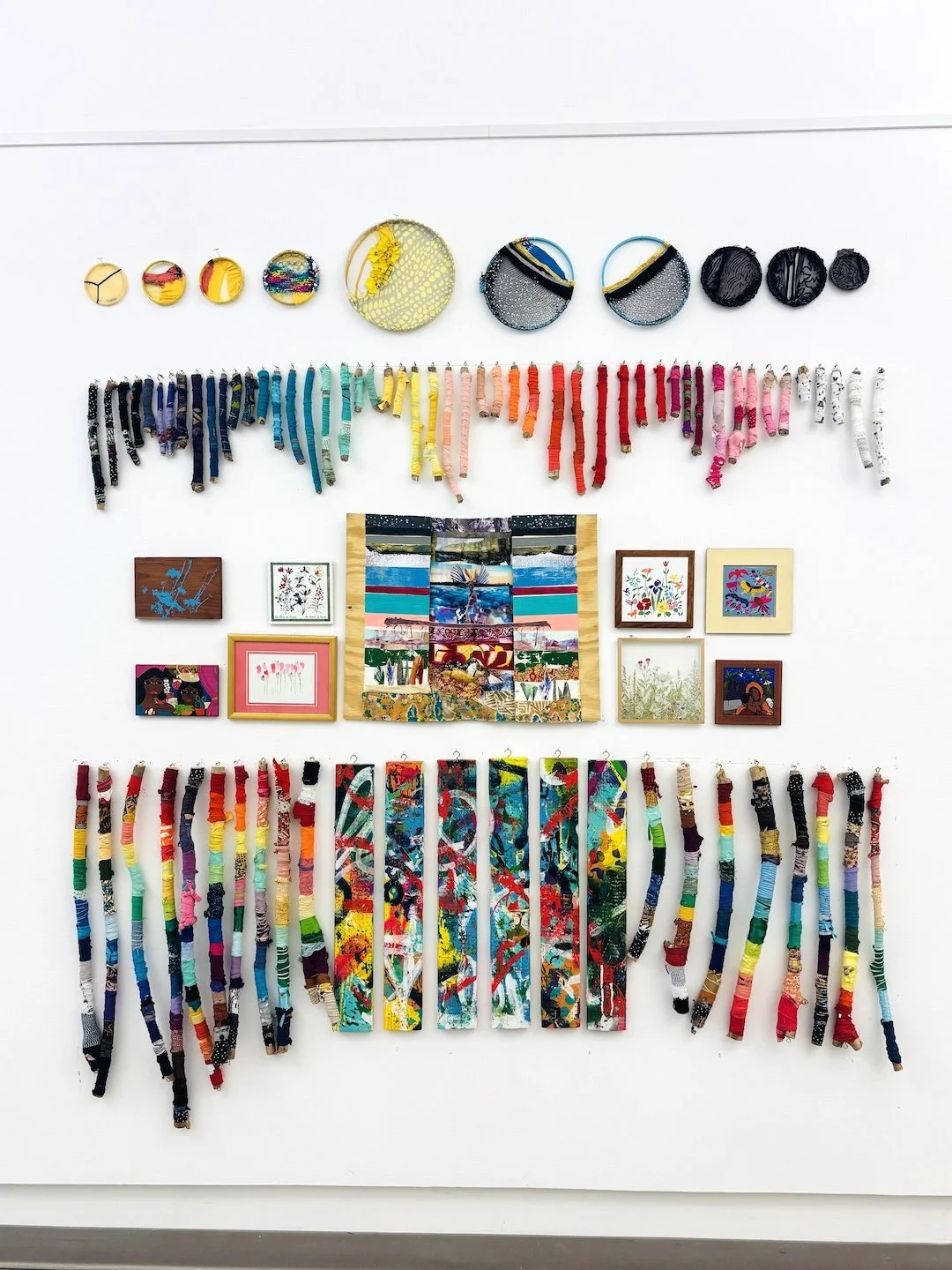
8. La traza de mis reinos ancestrales, mis flores y los dominios dentro (The charting of my Ancestral Realms, My Blossoms and the Dominions Within), Installation design by Manning Harper (Student Worker) and Amber Robles Gordon, Mixed Media Installation, 2026
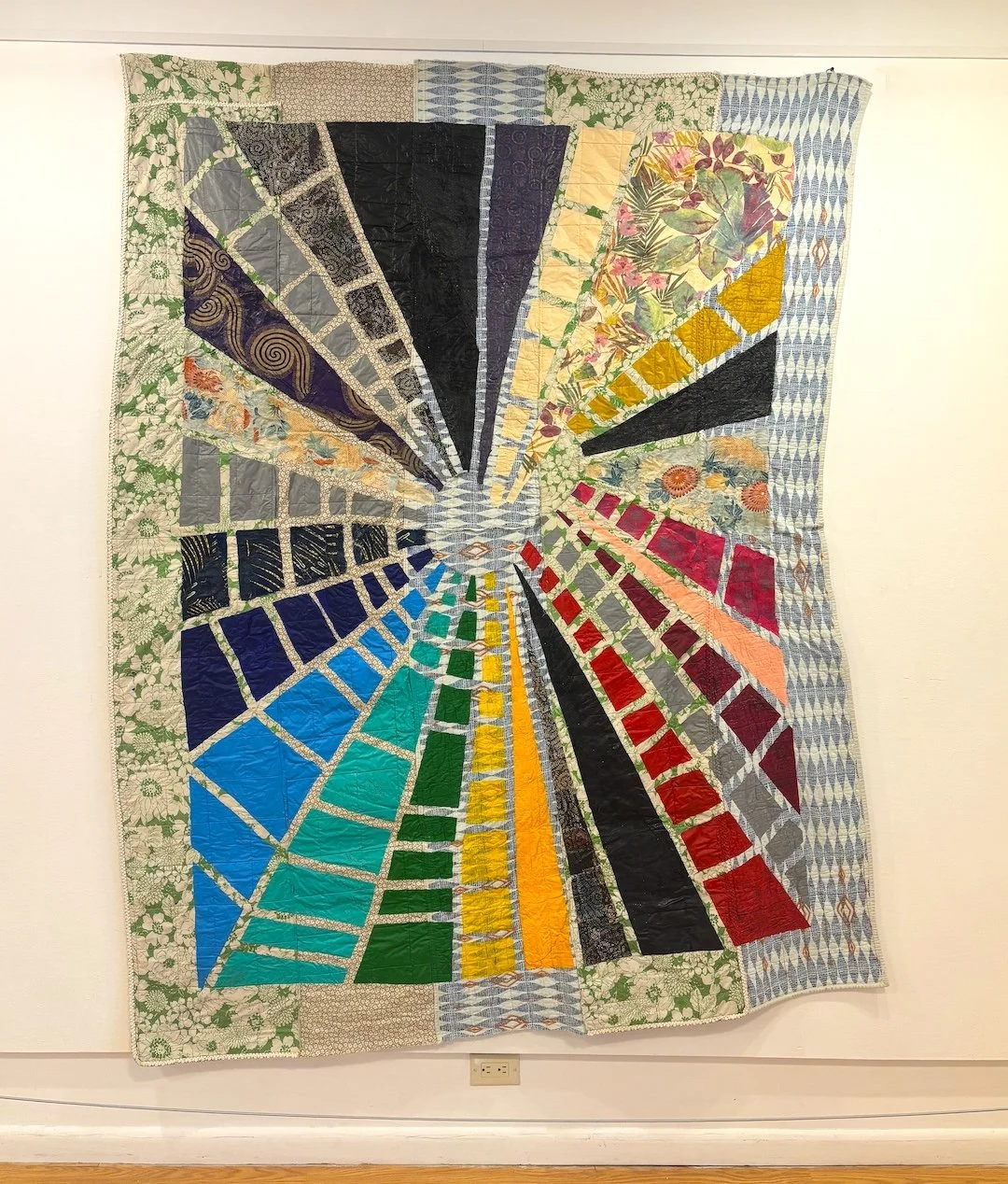
9. Restos (Remnants), mixed media quilt/installation, 68 x 94 in., 2023
Installations
1. Yo, tú, nosotros, creamos naciones, a través del amor, la verdad y la reflexión, ( I , you, we create nations. Through love, truth, and reflections), 2026
2. Soy luz, amor y frecuencia amplificada (I am light, love y frequency amplified) Mixed Media Installation, 2026
3. Despertando lo matrilineal, llamando a todos los puntos cardinales las direcciones. Y la gimnasia matemática de la morenitud y la negritud (Awakening the Matrilineal, Calling All Directions. And the Mathematical Gymnastics of Brownness and Blackness), 2026
4. Mitigación del racism (Mitigation of Racism), 2026
5. Lo que merecemos y se nos debe: Reparación, Restauración y Posibilidades Infinitas (What we are deserving and owed: Reparation, Restoration and Infinite Possibilities), Mixed Media Installation, 2026
6. Anatomía del cuerpo infinito (Infinite Body Anatomy), Mixed Media Installation, Mixed Media Installation, 2026
7. Administración divina de la tierra, el cuerpo y la mente. (Divine stewardship of land, body and mind.)
8. La traza de mis reinos ancestrales, mis flores y los dominios dentro (The charting of my Ancestral Realms, My Blossoms and the Dominions Within), Installation design by Manning Harper and Amber Robles Gordon, 2026
9. Restos (Remnants), mixed media quilt/installation, 68 x 94 in., 2023