
D.C.-based artist Amber Robles–Gordon has created assemblages that cover swaths of the walls and floor, forming symmetrical arrangements of original paintings and objects along with bric-a-brac that could have been pulled right out of granny’s house. Among these talismans are coasters, sticks wrapped with rainbow thread, embroidery samplers, vividly painted wood planks, and live plants in glass cubes of water.
Read MoreWashington City Paper
In Shoulder the Deed, Artists Reflect on the Present and the Past
in Event
In the exhibition Shoulder the Deed at Eckington gallery STABLE, the curators have gone back and fetched a history that strengthens the establishment not only of STABLE, but also of the Black artists living and working in D.C.
by SHANTAY ROBINSON JULY 15TH, 2021
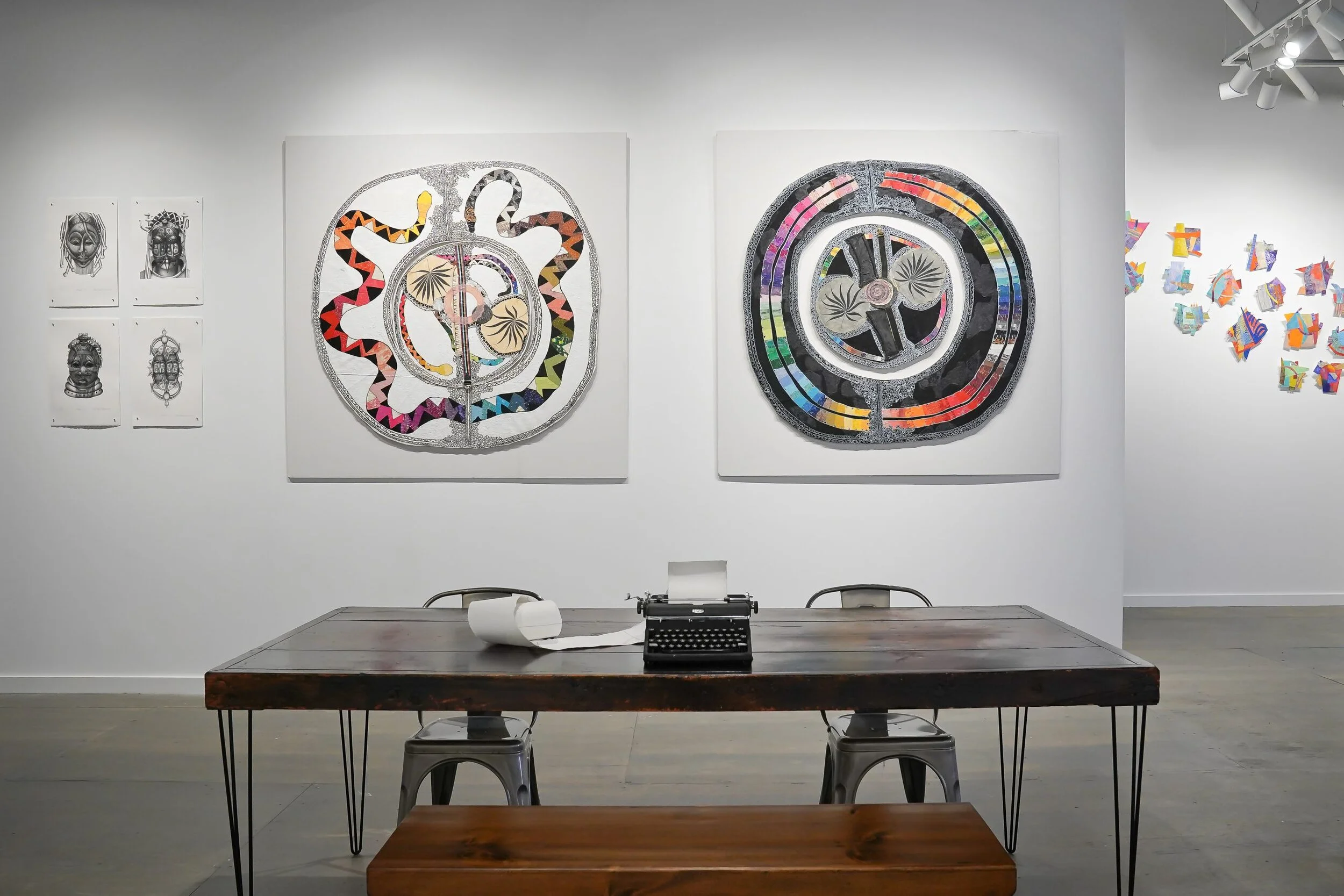
Photography courtesy of Tony Powell.
Image Description:
(center) Starr Page.‘The’ James Baldwin Table, 2018.
(bottom center) Amber Robles Gordon The Male, The Architect, The Protector (Outer Circle) The Universe (inner circle), 2017, The Female, The Oracle, The Nurturer, (outer circle), 2017.
(left) Gail Shaw-Clemons,. Masks, 2020.
(right) Aziza Gibson-Hunter, Gri Gris, for the First Wave of the Third Millennium, 2020.
Originating from the Akan people of Ghana, the term Sankofa is often associated with the proverb “Se wo were fi na wosankofa a yenkyi,” meaning “it is not taboo to go back and fetch what you forgot.” The Adinkra symbol for the concept is a mythical bird flying forward with its head turned backward. In the exhibition Shoulder the Deed at Eckington gallery STABLE, the curators have gone back and fetched a history that strengthens the establishment not only of STABLE, but also of the Black artists living and working in D.C. STABLE, in collaboration with the Black Artists of D.C., presents an impressive collection of artworks steeped in rich African and African American traditions. As you enter the space, the wall to the right features photographs of some key personages such as Harlee Little and Juliette Madison, who, beginning in 1985, envisioned a space where Black photographers could commiserate and work. Shoulder the Deed is a spiritual reckoning. The artists in the exhibition, spanning several generations, come together to travel through time to bring forth conceptual and even modern works that speak to Black experience through portraiture, video art, assemblage, and more.
Before seeing the artwork, Black presence is felt and sets the tone for the exhibition. Upon entering the gallery, the sounds from Shaunté Gates’ video work “Free Breakfast Program” hauntingly quiets the mind. The repetitive loop of phrases such as “By their very presence…” and “I was always here …” over a go-go rhythm signals that we are in Black space, if the artworks had not already signaled this. The sound draws you to the work full of edited and manipulated images, displaying a history of the Black experience. The archival historical footage is juxtaposed with more recent archival footage as Black people perform traditional African dance and B-boys break.
While Gates’ work references relatively recent history using media technology, Gina Marie Lewis confronts history with an ancestral altar. “Libations for the Journey” is a mixed media work that uses images, cowrie shells, bottle corks, seashells, champagne, and door handles to offer the ancestors access and vision on a journey. A wooden box depicting a slightly open door sits in the middle of the altar as a doorway to the past, with candles inside to light the way in the darkness. This generous offering to the ancestors allows the artist to look to the past to create a path to the future spiritually. Lewis uses traditional technology to reach back in time to secure the blessings of the ancestors on a journey forward.
In keeping with the theme of looking at the past, Stan Squirewell’s “Monk Hancock (Innocent Criminal Series)” combines ancient times with the present in a portrait that is a mashup of a modern-day Black man dressed in a black winter coat manipulated with an overlay of the facade of an Egyptian statue and the bodice of a Roman one. Looking back to notable periods in history, Squirewell tells a contemporary story about the fight for survival. The portrait allows for a connection between how a contemporary Black man must fight for his life, much like those who have gone before in other treacherous times.
Nekisha Durrett’s “Magnolias” says the names of women whose lives were lost too soon. In a light box, the names of three women are highlighted on magnolia leaves. These unarmed women were killed by police, referencing the threat unarmed Black women face in their everyday existences. The stories of these women’s deaths are all too common today, but by saying their names, Durrett remembers them and encapsulates their circumstance for others to know and remember their fates.
The artworks in the exhibition work together; Michael Platt’s “Evening Ritual,” a painting of a nude Black woman depicted eight times and composed in a circle, alludes to the “magic” that Black women have been known to perform for centuries. The subject of the painting looks directly at the viewer from many angles as we witness her in ritual. The idea reminds viewers of the spectatorship Black people have gone through as the “other.” The defiance in the subject’s response shows she is not threatened by the gaze of the viewer.
In several ways, the artworks speak of the present while at the same time referring to the past. From modernist tendencies to conceptual leanings, the show represents an array of works that belong in the same exhibition space but are each unique in their perspective. As a continuation of STABLE’s relationship with Black artists for almost four decades, this exhibition represents the importance of looking back to the foundation for clues on the direction to take next. Each of the artworks in Shoulder the Deed has a distinct quality that makes visitors want to see more from the artists. The artwork in this exhibition looks at the past while representing the contemporary moment, moving us into a more conscious future.
At STABLE to Sept. 30. 336 Randolph Place NE. (202) 953-9559. stablearts.org.
This story has been updated to clarify Little and Madison’s connection to STABLE.
Solo exhibit featuring Amber Robles-Gordon opens at WC's Kohl Gallery
in exhibit
Material-isms: The Cultivation of Womanhood and Agency Through Materiality
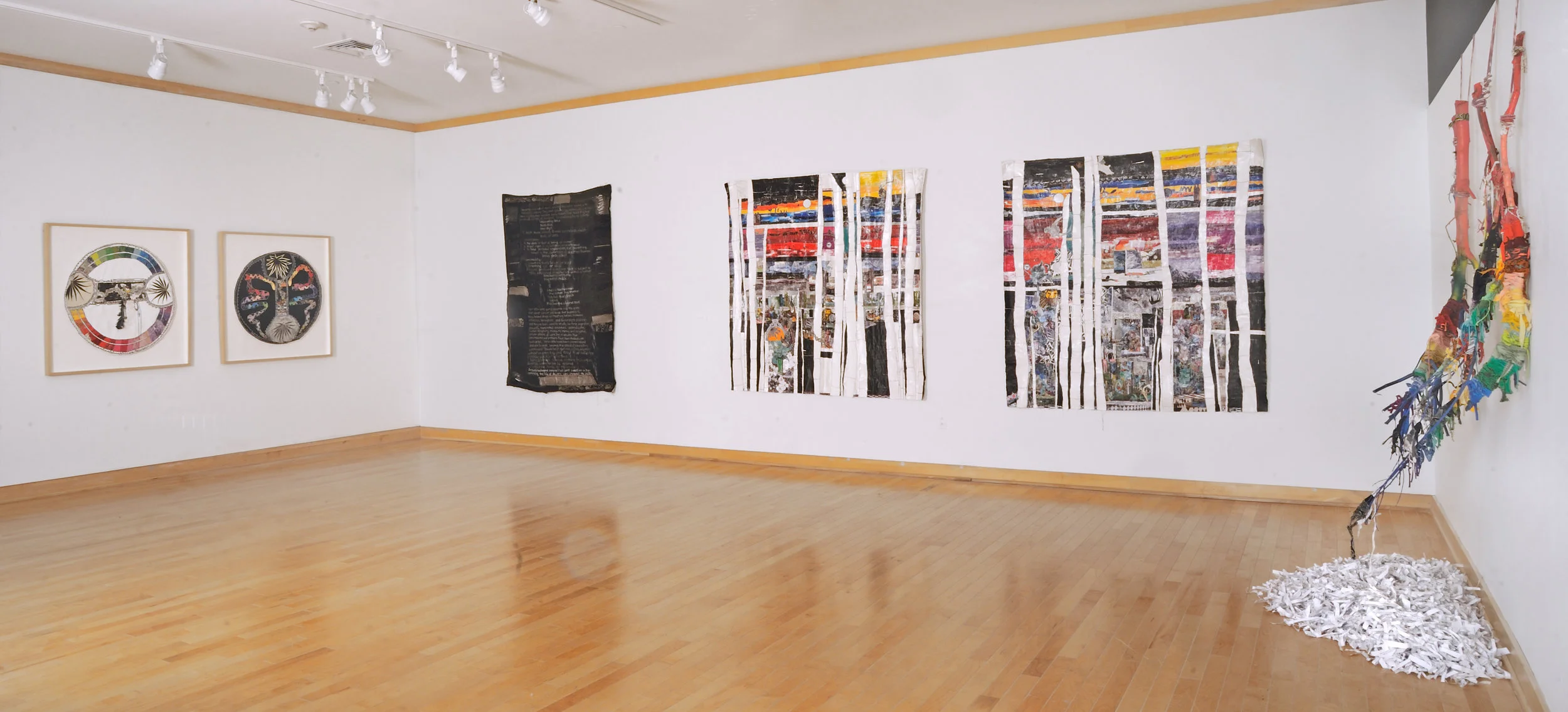
CHESTERTOWN — The Kohl Gallery at Washington College kicks off the 2018-19 academic year with a solo exhibit "Material-isms: the cultivation of womanhood and agency through materiality," featuring Washington, D.C.-based mixed-media artist Amber Robles-Gordon.
The exhibit features assemblage and installation works created from a range of found objects and textiles.
Opening on Thursday, Sept. 6, with a public reception from 4:30 to 6:30 p.m., "Material-isms" will run through Oct. 10. Robles-Gordon will also deliver a public talk in the gallery at 3 p.m. Thursday, Sept. 13.
According to a news release, Robles-Gordon’s artistic practice draws upon the often-paradoxical experiences of her gender, ethnicity and social and cultural influences, including her Latino, African and Caribbean heritage.
The release states, what the artist calls “hybridism” is reflected in her varied material strategies and vibrant use of color, often invoking a spiritual and energetic sensibility.
“Materials intrigue me, but colors uplift and excite me,” Robles-Gordon said in a 2017 interview with Bmore Art Magazine.
"Material-isms" will highlight Robles-Gordon’s spirited use of a bold color palette in a series of mixed-media and installation works that conjure themes of femininity and masculinity, duality, spirituality and the natural and cultural environment.
Robles-Gordon earned her Masters in Fine Arts from Howard University and has more than 15 years of experience as a practicing artist, curator and arts educator.
Her work has been reviewed or featured in The Washington Post, Washington City Paper, Hyperallergic, Huffington Post, ebony.com, The Miami Herald, Bmore Art Magazine, Support Black Art and Callaloo: Art and Culture in the African Diaspora, among other publications.
Robles-Gordon’s work has been exhibited throughout the U.S. and in Germany, Italy, Malaysia, London and Spain. She has created temporary and public installations for the DC Commission on the Arts and Humanities, the Northern Virginia Fine Arts Association, Howard University, The Schomburg Center for Research in Black Culture, Washington Project for the Arts, Salisbury University and Martha’s Table.
In 2012, Robles-Gordon was selected for Under the Influence, in association with the Corcoran Gallery of Art’s 30 Americans exhibit. As an arts advocate, Robles-Gordon has served the Washington, D.C. regional arts community as an active member of Black Artists DC, serving as exhibitions coordinator, vice president, and president. She is also the co-founder of Delusions of Grandeur Artist Collective.
Kohl Gallery is located on the first floor of the Gibson Center for the Arts at Washington College in Chestertown, Maryland. The gallery is open Wednesday through Friday 1:30 to 5:30 p.m.; Saturday and Sunday noon to 4 p.m. For more information, email: kohl_gallery@washcoll.edu.
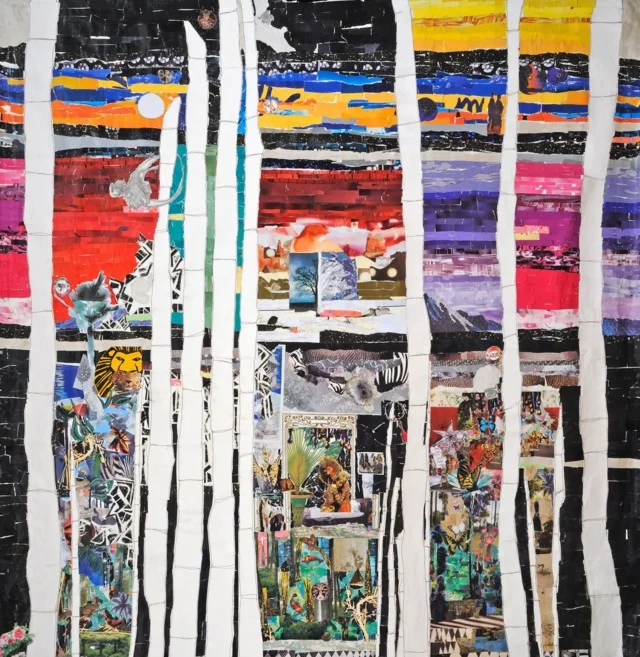
"Interdimensional Realms" by Amber Robles-Gordon
At Hemphill Fine Arts, The Past, Present, and Future of Abstraction
"MORE or LESS" showcases how D.C.'s affinity for Abstraction has always been a part of its artistic DNA.
by KRISTON CAPPS, Washington City Paper
MAY 24, 2018 11 AM
Process-based abstraction has always been a staple of painting in D.C. The Washington Color School was built by artists who defined their work by their approach to the canvas, whether by staining it or draping it or something else. MORE or LESS, a group show on view at Hemphill Fine Arts, shows how new trends in contemporary painting continue to line up with the work that put D.C. on the map in the 1960s and ’70s.
Read More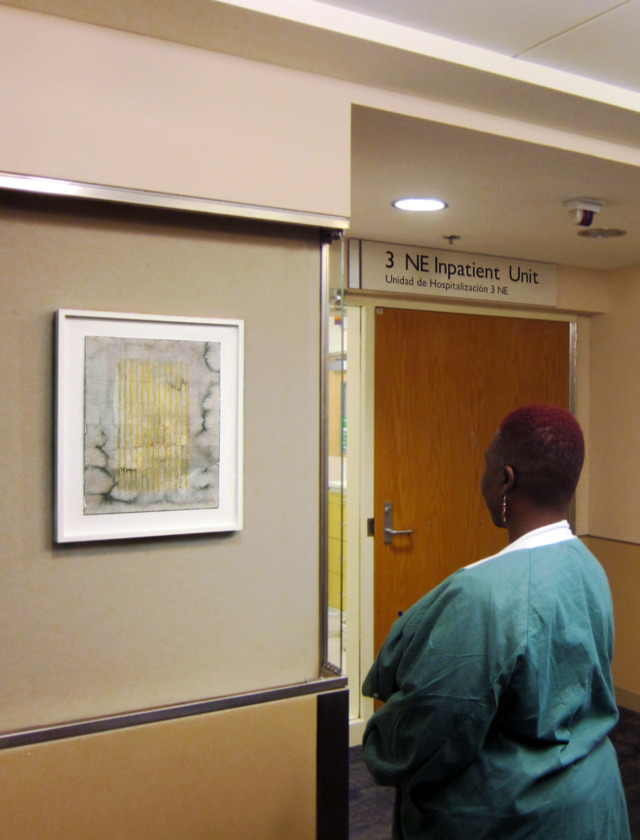
A woman views a painting by Mary Early.
At the Washington Project For the Arts, Beltway Public Works Showcases a Lending Library For Art The WPA's latest exhibition introduces the idea of art on loan to the public.
in review
At face value, there’s an able group show at the Washington Project for the Arts, filled with work that ranges from the aesthetically pleasing, to the conceptual, and the socially relevant. A 55-color lithograph, “Ramble,” by Benjamin Edwards, is a dizzying map exploding with color and shape. Margaret Boozer’s “Red Dirt Print,” a four-foot square patch of dirt, re-contextualizes the ground beneath our feet into an aesthetic object to hang on the wall. Naoko Wowsugi’s “Thank You For Teaching Me English” presents several photographed portraits against high-key color backgrounds: people mouthing English words for the artist to learn (English is her second language).
Read MoreThe art of Amber Robles-Gordon is the art of Anacostia, quite literally.
in review
Robles-Gordon cobbles together sculptures and canvas collages from scraps of paper and fabric she finds in the neighborhood’s trash cans and storefront windows. She’s shown her work at the Honfleur Gallery. Right now, she has a striking wire and fabric mesh artwork on view near the Deanwood Metro stop.
But as ARCH Development Corporation continues to expand its constellation of arts destinations in Anacostia—the latest is the Anacostia Arts Center on Good Hope Road SE—Robles-Gordon wonders if her neighborhood will still have room for her.
There’s a tendency to see Anacostia, long on talent and struggle but short on just about everything else, as a blank canvas. With the right kinds of art and advertising, the thinking goes, Anacostia can become a hub for the creative class. But who gets left out?