
review

Driskell Center’s Newest Exhibit Aims To Reshape The Meaning Of Black Sisterhood

Driskell Center’s Newest Exhibit Aims To Reshape The Meaning Of Black Sisterhood

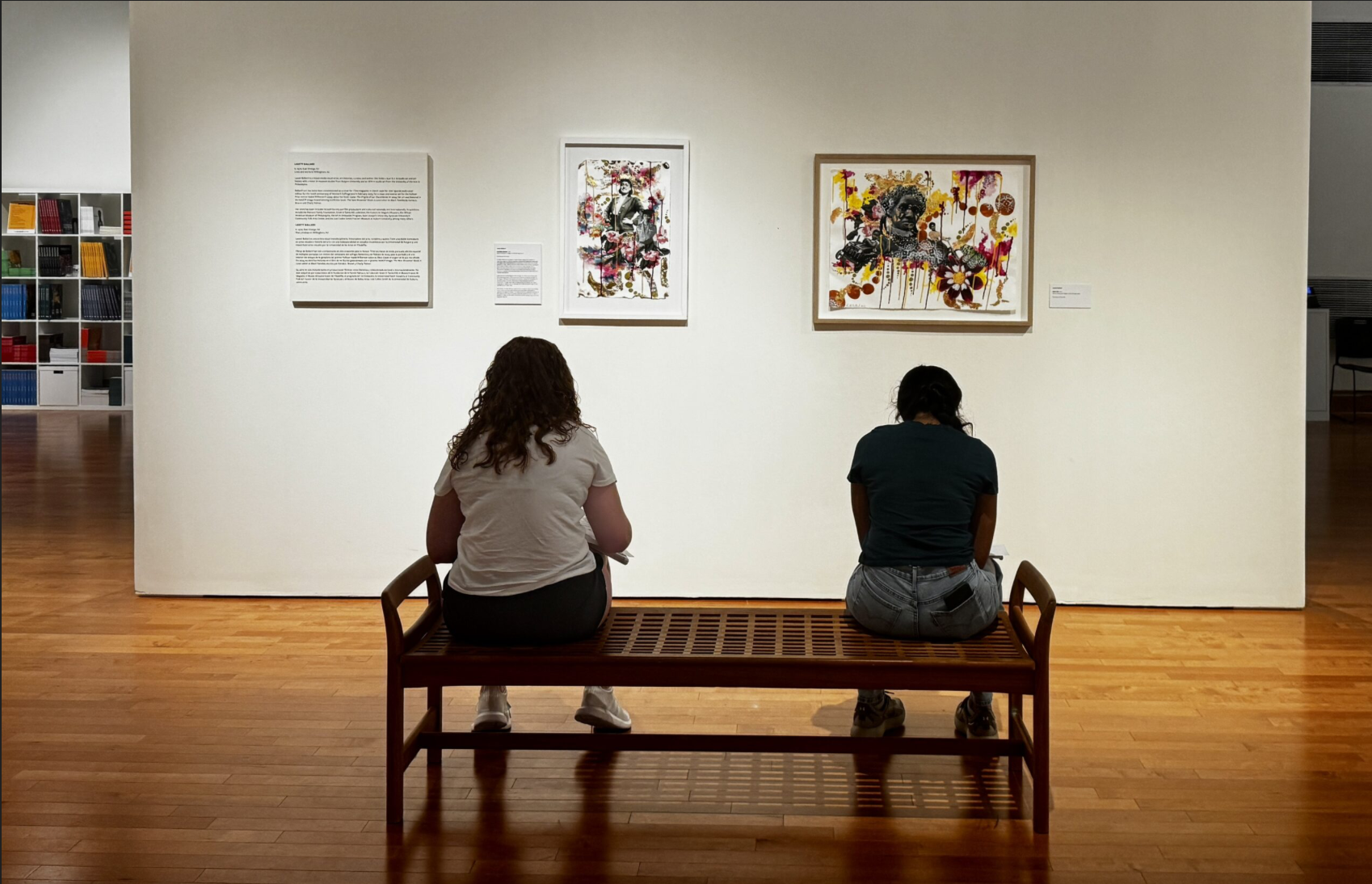
Solace and Sisterhood, The Driskell Center’s fall semester exhibit, amplifies the resilience and bond of Black sisterhood through the varying perspectives of three prominent female artists.

The exhibit, which is on view until Dec. 5, aims to encompass a diverse range of relationships between women, from biological relationships to friendships. It showcases the impact sisterhood has on these relationships and examines the solace and understanding Black women in these relationships receive, according to a press release by The Driskell Center.

Read More

Amber Robles-Gordon: sus raíces y herencia vistas a través del arte

Por Periódico El Adoquín/Publicado 17/05/2023 a las 4:59 pm/Actualizado 02/11/2023 a las 5:09 pm/7 min lectura

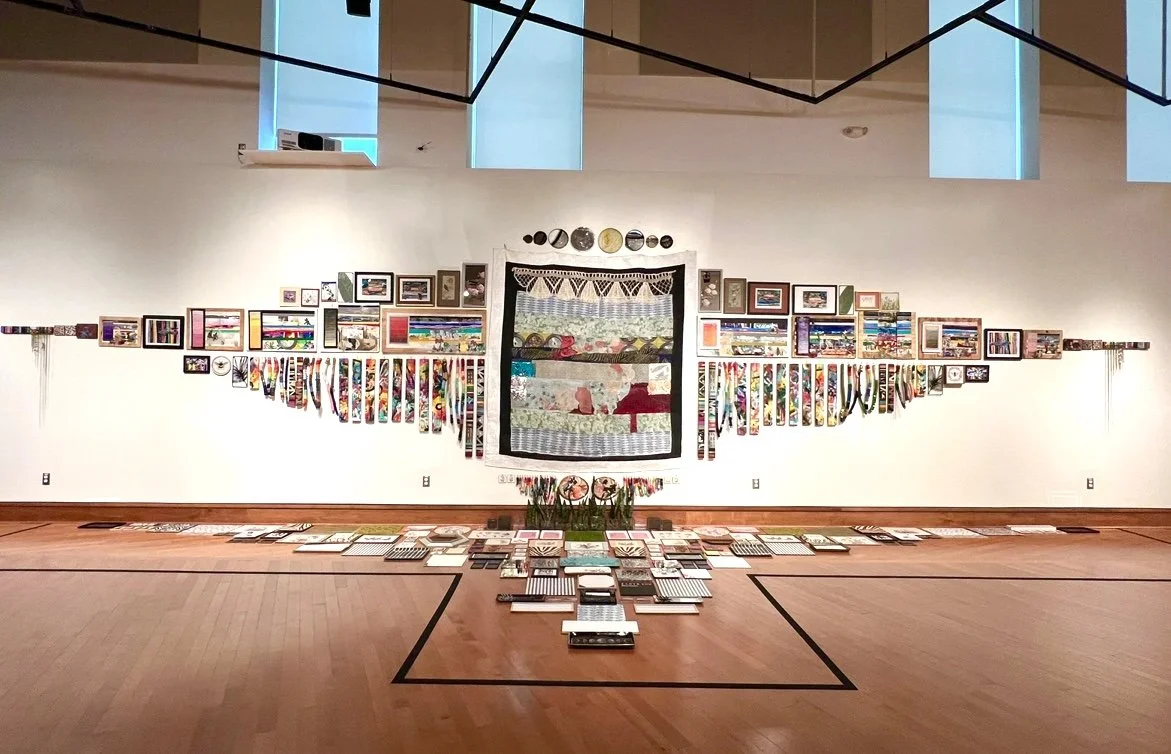
La artista nacida en San Juan y criada desde pequeña en Arlington Virginia, Amber Robles-Gordon, está presentando la primera exposición individual en línea, Place of Breath and Birth, en la Galería de Arte de la Universidad del Sagrado Corazón, en Santurce.

Su trabajo artístico representa un retrato de sus recuerdos de niña. Según nos cuenta en entrevista, este momento en la vida de la artista fue muy complejo, no solamente por encontrarse en un nuevo lugar a temprana edad, con una cultura e idioma totalmente diferente a la de San Juan, pero además por el discrimen que la recibió en aquel entonces. Esta exposición es dedicada a esa parte de su vida y su afán por recuperar su herencia.

Desde muy niña,a Amber Robles-Gordon su mamá le enseñó la importancia de apreciar y valorar el arte y las expresiones culturales. Recuerda cuando iba al Instituto Smithsonian a ver importantes piezas, en especial le llamaba la atención las de impresionismo. La artista se acuerda hasta de su primera maestra de arte que le enseñó cómo crear un collage, al lograrlo, se sintió muy orgullosa. Luego, se dio cuenta de su talento y decidió dedicarse como artista.

A preguntas del discrimen que tuvo que experimentar desde su llegada a Estados Unidos, Amber Robles-Gordon nos cuenta que: “Por ejemplo, no puedo recordar lo que realmente se me estaba diciendo. Solo recuerdo esa sensación de que no quería que continuara por lo que no quise hablar más el español. Yo de cinco años no sabía cómo hacer que se detuviera [el discrimen]. Pensé que se basaba en el idioma que estaba hablando y ellos no entendían por qué lo estaba hablando. A los cinco años tomé la decisión y pensé que, si dejaba de hablarlo, tal vez la gente no se burlaría”, expresó Amber Robles-Gordon.

La artista añadió que los latinos también “somos personas de color”, por lo que hay que tomar decisiones sobre quiénes somos en la sociedad y cómo reclamamos nuestro espacio e interactuamos con los demás.

“Creo que todos nosotros hemos tenido que tomar una decisión en algún momento u otro sobre cómo nos representamos y cómo representamos nuestra cultura. Es solo que no sabía que la decisión que tome a los cinco años iba a ser tan duradera y algo tan serio en mi vida. En aquel momento sentía que, si no era mi idioma, iba a ser otra cosa… tenía que negociar para que fuera aceptada. No te das cuenta de que, acomodando la forma de pensar de otras personas, se va acumulando un sentimiento. Luego me di cuenta de que, como mujer negra, debía reclamar mi postura”, indicó la artista, quien explicó que precisamente esta exposición la utiliza para empoderar a aquella niña de cinco años de aquel entonces.

Cómo surge esta exposición Place of Breath and Birth

Amber Robles-Gordon expresó que siempre quiso regresar a Puerto Rico, obtener nuevamente su idioma y reencontrarse con familiares y seres queridos en la Isla. La primera vez que intentó retomar el español fue terminando su posgrado cuando tuvo la opción de elegir estudiar otro idioma, pero en ese momento su hijo fue diagnosticado con pérdida auditiva, por lo que tuvo que tomar una decisión: ¿español o lenguaje de señas en inglés?, y como ella misma expresó: “decidí poner a mi hijo primero”.

Una vez su hijo ya estaba más grande, la artista tomó nuevamente la decisión de regresar a la Isla y sanar esa parte de ella. Durante aquel momento, hace contacto con Edwin Velázquez Collazo, ya que él incluía su trabajo de diferentes maneras en su blog Puerto Rico Art News. “Así que alrededor de unos años antes del 2019, me encontré con alguien que estaba valorando mi trabajo, así que tuve una conversación con él [Velázquez Collazo] agradeciéndole. Hablando con él investigué de cómo regresar a Puerto Rico, para encontrar esos pedazos de mí que había escondido de niña”, señaló la artista. Velázquez Collazo le recomendó entonces que contactara a la Universidad del Sagrado Corazón y les presentara una propuesta.

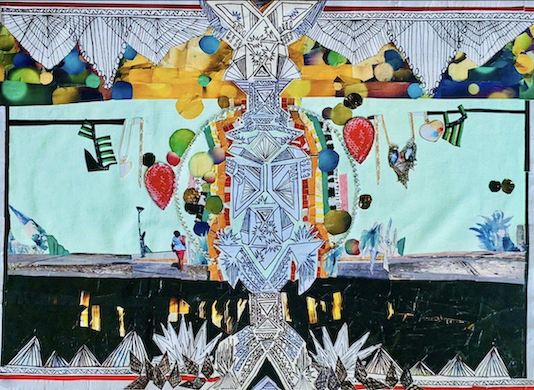
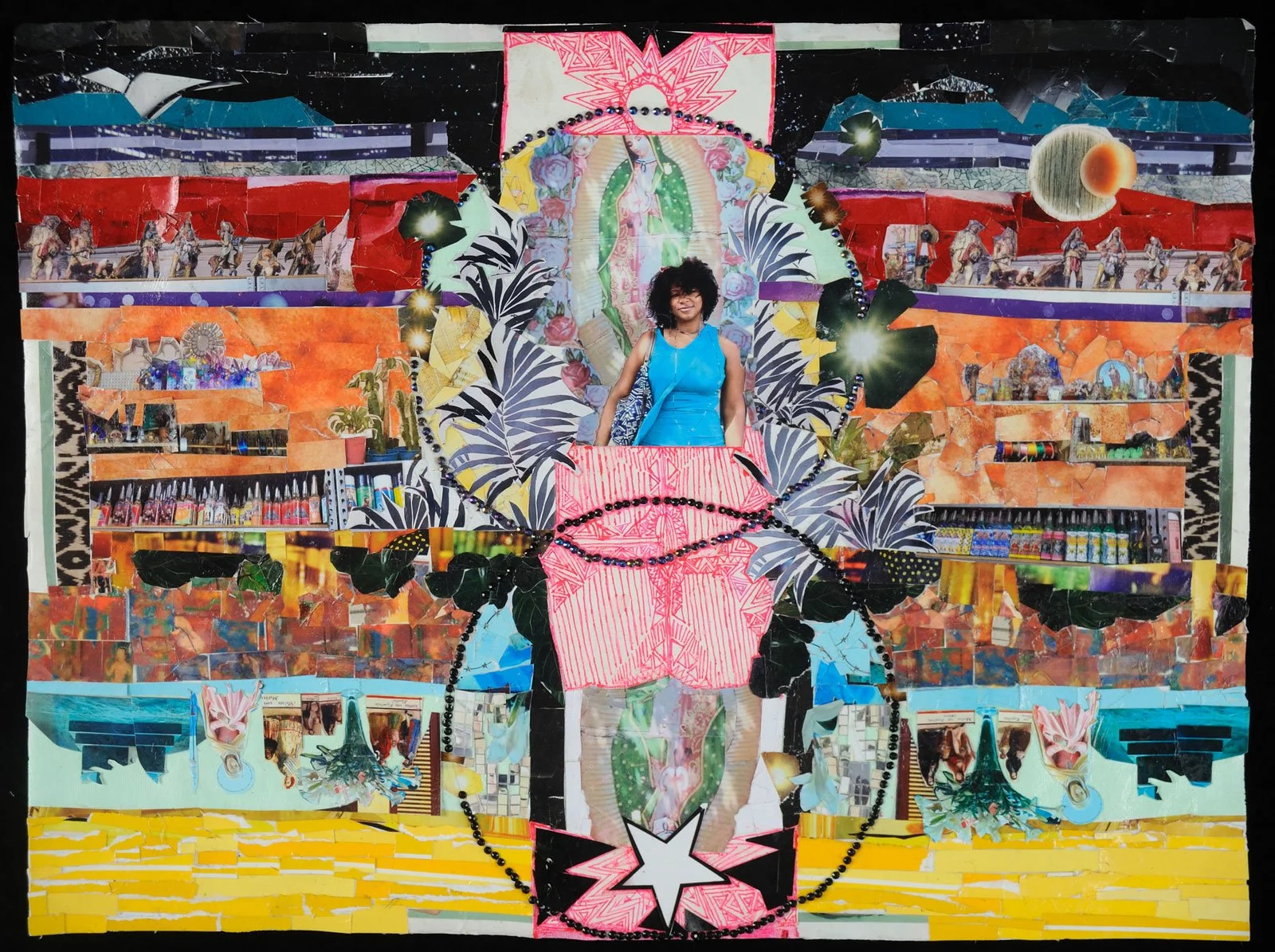
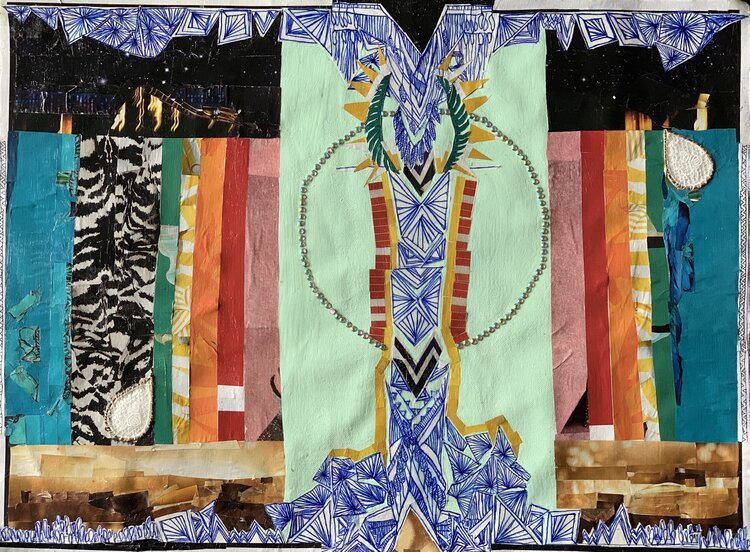
Tendedero Comunidad y Energía Eterna 18 x 24 2020

Por razones de la reciente pandemia la Galería tuvo que cerrar y convertirse en una virtual, Amber Robles Gordon decidió venir a la Isla, donde estuvo alrededor de tres meses. A pesar de que estaba planeando estar más tiempo, no pudo hacerlo ya que Puerto Rico estaba ajustando más las reglas de precaución y la artista tenía compromisos también en Estados Unidos, por lo que tuvo que regresar. A pesar de esto, aclara que cada pieza de esta exhibición la comenzó en Puerto Rico para terminarlas luego desde Washington DC.

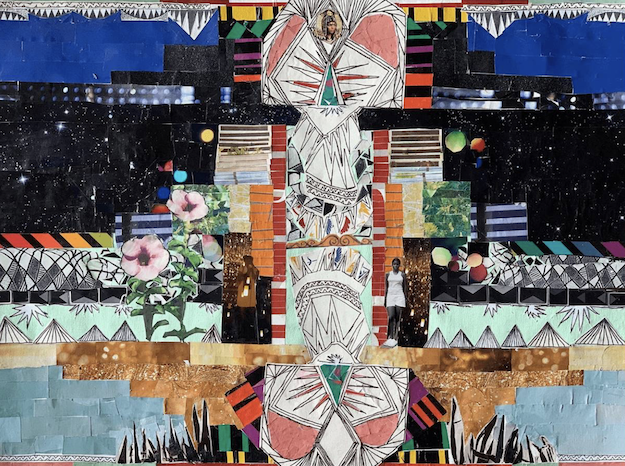
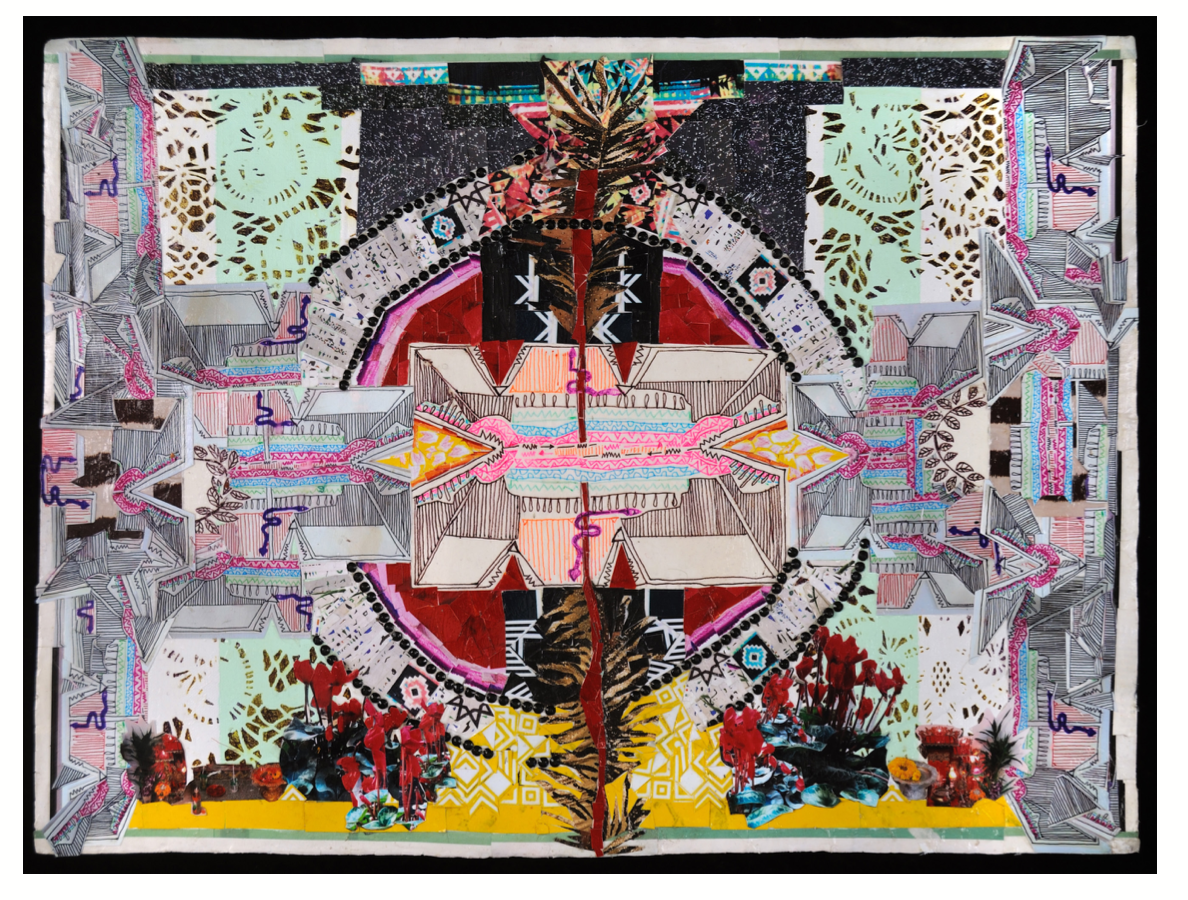
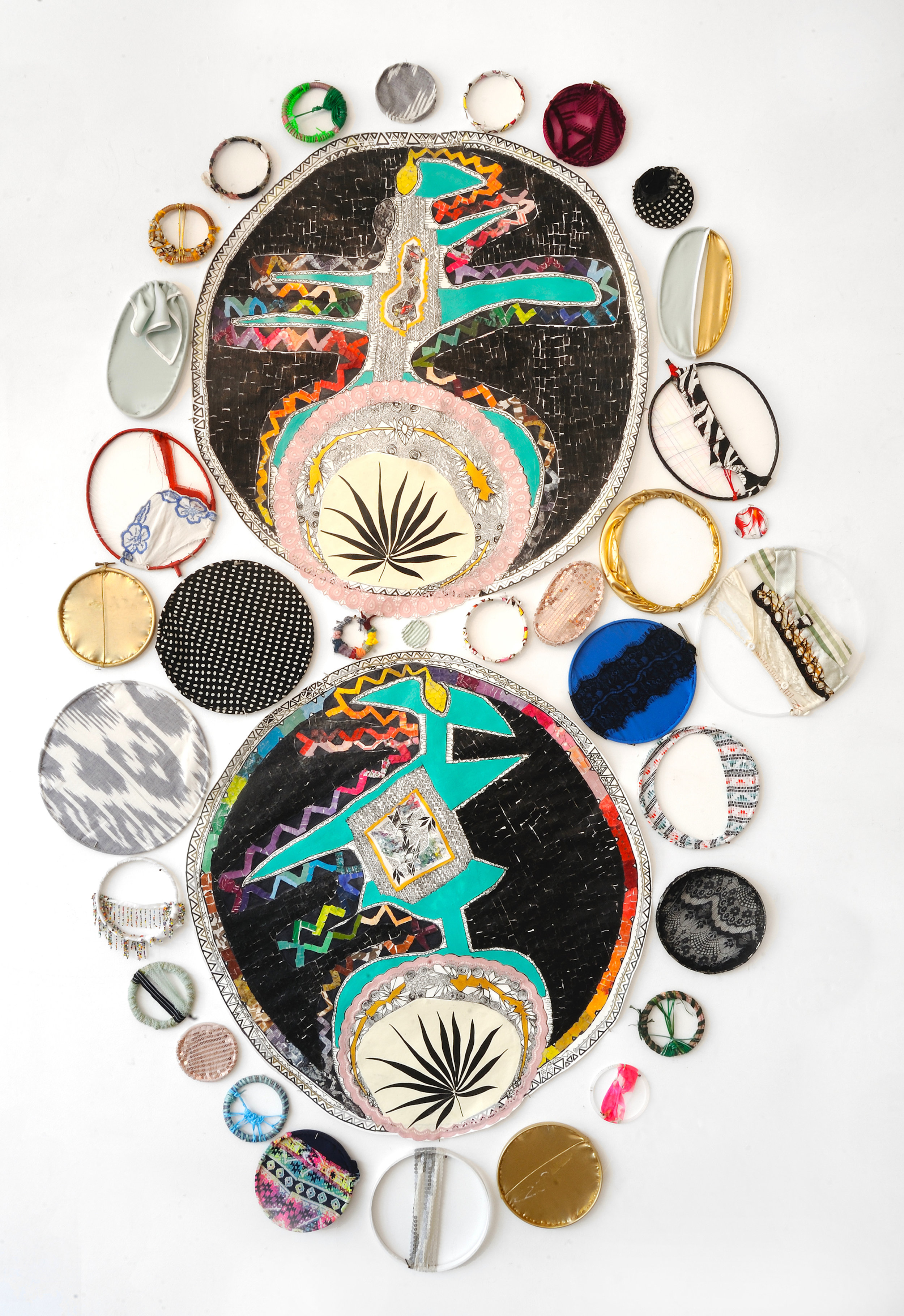
Amber Robles disfruta mucho los colores y trabajar con diferentes texturas, principalmente en telas. Como parte del análisis y el estudio que realiza para sus obras de arte, hace dibujos o “sketches”. Precisamente, durante el viaje que realizó con su madre en la Isla, se dijo que iba a hacer dibujos a través de todo el viaje, todos los días. “Así que con estos dibujos me di cuenta que estaba haciendo la parte abstracta de Fiscus Elástica, nombre que le da a la parte central en las piezas de la muestra. A pesar de que no me gusta la naturaleza, porque no me gustan los mosquitos, si me gustan mucho sus colores, cómo las plantas nos cuidan y la relación que tenemos con ellas”, señaló.

Cuando llegó al campus de la Universidad del Sagrado Corazón, observó que los árboles tenían sus nombres, viendo una relación de algún tipo, hasta familiar. “Vi la representación de las raíces, lo que era como una versión familiar y de comunidad de la naturaleza y lo que significa eso para mí. Yo no me di cuenta de lo conmovida que estaba (en ese momento) con los árboles”.

Botánica del Amor, Autoreflexión y Espiritualidad 18 x 24 2020

“Cuando ves las obras y los colores de esta colección; por ejemplo, el verde menta se encuentra en todas las piezas. Cuando estuve en Puerto Rico fue un color que utilizaba mucho para decorar, por lo que quise utilizarlo en todas las piezas. Decidí utilizar los sketches que tenía como base, y terminaron convirtiéndose en una de las capas más importantes del trabajo”, añadió.

A preguntas de este medio de cómo se sintió al terminar esta serie, expresó: “Definitivamente hay un sentimiento de orgullo al terminar la serie. Esta fue la primera que hice específicamente de algo tan importante para mí como lo es mi herencia”.

Detrás de la elaboración de cada trabajo, ciertamente hay un elemento de la expresión de emociones. Durante esto, sintió que estaba como en una excavación, porque “estaba aprendiendo sobre muchas cosas que no sabía cómo decirlas o presentarlas. Era como si estuviera pelando o dejando ver las diferentes capas de mi personalidad”, expresó Amber Robles-Gordon.

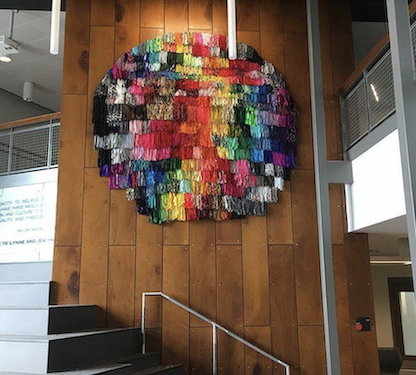
Su trabajo incluye esculturas, pero muy diferentes quizás a lo que uno está acostumbrado, muchas de ellas están creadas con telas de colores. Sus trabajos escultóricos tienen que ver mucho con la cultura afrodescendiente.

Disfruta hacer el trabajo a gran escala. A pesar de que considera que ha sido afortunada de haber hecho arte por tanto tiempo, entiende que hay ciclos, por lo que cuando se le comisiona una pieza, ya ella tiene pensado los materiales, ha escogido telas y empieza a armar esa pieza basado en lo que ha coleccionado. Va apartando los materiales para próximas piezas, pues se convierte todo en un ciclo para la artista.

Lo más reciente…

En la actualidad, la artista Amber Robles-Gordon está trabajando en un proyecto junto a Semilla Cultural, organización en la que están realizando un proyecto donde tiene que aprender el baile de bomba. Para éste, ha reunido un grupo de mujeres, entre ellas su madre, junto a la maestra Isha Renta.

Por otra parte en International Arts and Artists at Hillyer, en Washington DC, presenta la exhibición Remnants: a visual journey of memory and renewal en la que exhibe la pieza Soy luz, amor y frecuencia hasta el 28 de mayo.

Adicional, este sábado 20 de mayo a las 2:00 p.m. tendrá un conversatorio con George Hemphill, renombrado galerista en Washington DC, en la que hablarán sobre los fundamentos de su obra de arte actual, los hilos que la conectan con la Escuela de Color de Washington y un amor y aprecio inquebrantables por la obra de arte de Alma Thomas.

Hasta hace poco, mostró su obra en la exposición “Trenzando Identidades” en el Museo Casa Escuté de Carolina, junto a 30 artistas destacadas y emergentes afro-puertorriqueñas y en la que abordaron asuntos de raza, género e identidad en los medios de la fotografía, pintura, dibujo, arte digital, collage y el grabado.

Para más información, visite https://www.amberroblesgordon.com/

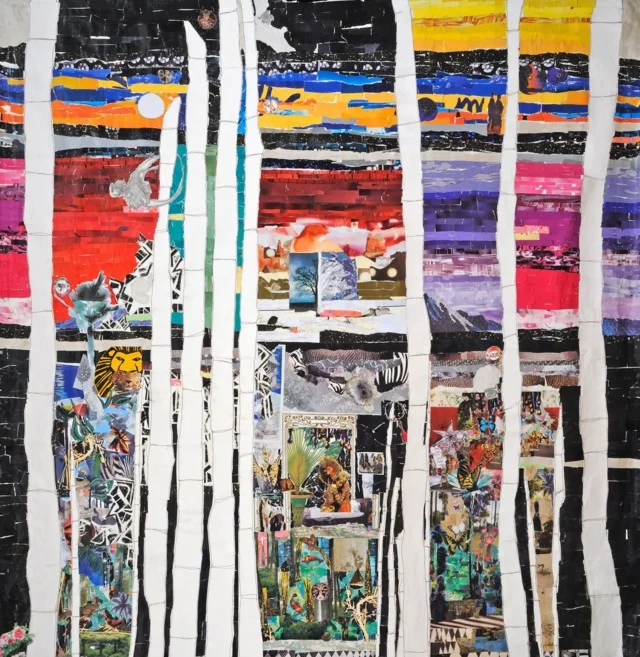
Spectrumatic Beacon, Commissioned Public Artwork, Textile on Chicken Wire, 2018

https://eladoquintimes.com/2023/05/17/amber-robles-gordon-sus-raices-y-herencia-vistas-a-traves-del-arte/

Dr. Kelli Morgan, Curator and Visual Artist, Amber Robles-Gordon in Conversation

Dr. Kelli Morgan, Curator and Visual Artist, Amber Robles-Gordon in Conversation

"These amazing and accomplished thinkers will be engaging in a discussion about the impressive visual presentation and critical investigations present Amber’s current exhibition on view at our gallery: soveREIGNty: Acts, Forms, & Measures of Protest & Resistance."

Read More

FEATURED: July’s First Saturday events will feature extended exhibitions worth a second look

FEATURED: July’s First Saturday events will feature extended exhibitions worth a second look

Tinney Contemporary will be sticking with its June show through July 9. I reviewed Amber Robles-Gordon’s Sovereignty exhibition for the Scene — it’s a prime example of how artists can incorporate political and social content into a body of work while also making art that’s formally striking. We’ve seen lots of messaging about social and political issues in the contemporary art of the 21st century. However, much of that work will never be remembered or reconsidered — timely art is rarely timeless. Robles-Gordon’s work is visually successful irrespective of its critiques of the U.S. policy toward — and governance of — its populated territories and the District of Columbia. I’ve seen powerful political art and dim political art, and I often question whether visual art is an effective medium for political messages. But the work in Sovereignty is formally distinctive. Tinney Contemporary will be open this Saturday from 2 to 8 p.m.

Read More

Hyperallergic

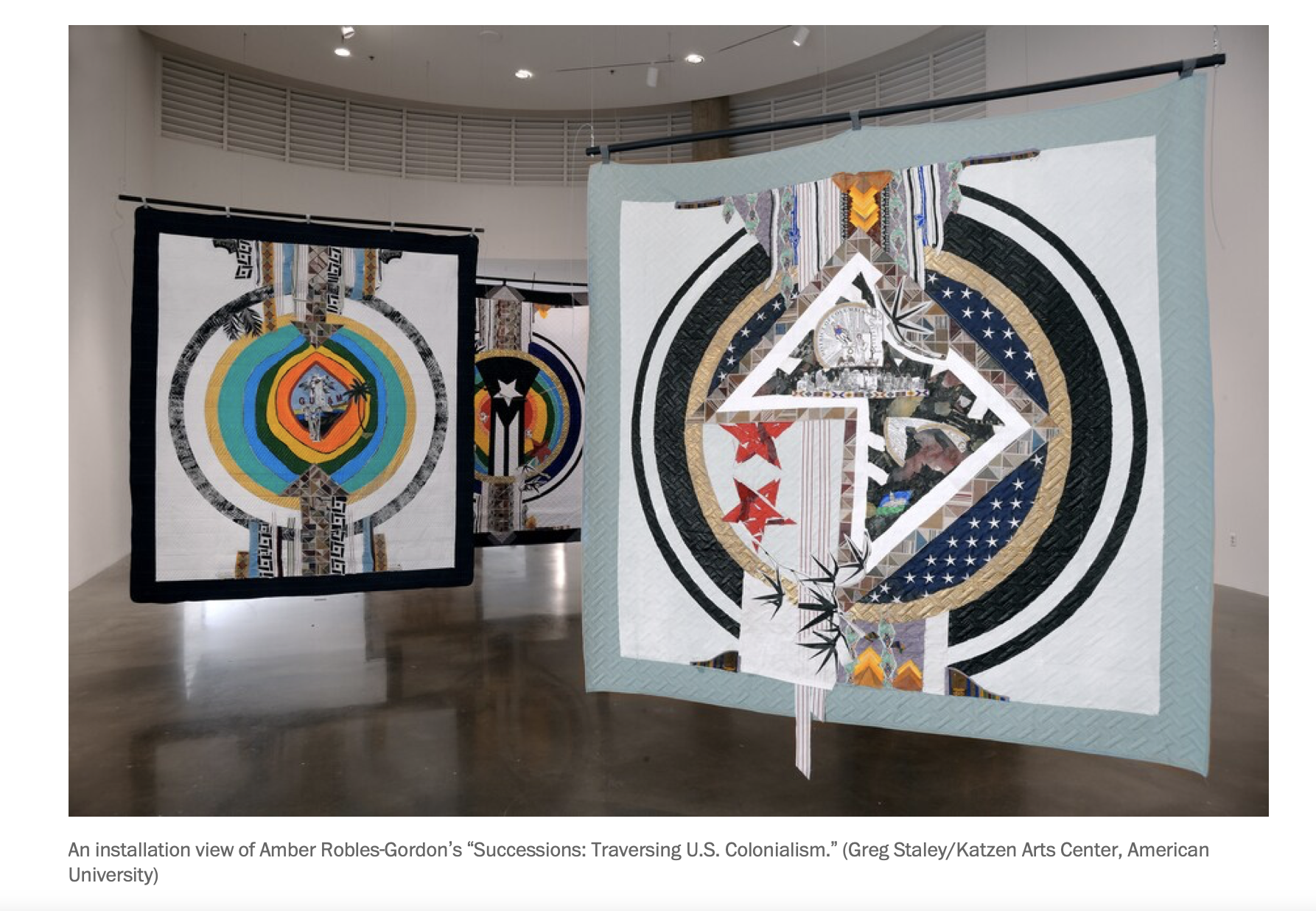
Washington, DC — Seven “flags” hang in Amber Robles-Gordon’s show at the American University Museum: one for each of the five unincorporated United States territories in the Caribbean, one for the District of Columbia, and one to signify the artist’s place in between those locales.

Read More

Bmore Art

People, food, and horticulture are among the things that move. Amber Robles-Gordon’s use of the Ficus Elastica is part of the symbology that reverberates throughout her exhibition, Successions: Traversing US Colonialism, on view at the American University Museum at the Katzen Arts Center in Washington, DC, through December 12, 2021. The Ficus Elastica—colloquially known as the rubber tree—has its roots in South Asia, though it was later nativized in the West Indies through the rubber trade. Dear reader, among your houseplants you are likely to find the genus of the rubber plant.

Read More

“Successions: Traversing U.S. Colonialism” on Exhibit at American University Museum

“USVI Spiritual, Moko Jumbie: Walk Tall and Heal Forward” Mixed Media on quilt, (back of “USVI Political”) 2021 (Courtesy of Amber Robles-Gordon)

Amber Robles-Gordon’s “Successions: Traversing U.S. Colonialism” has a dual purpose. It consists of her “Place of Birth and Breath” solo exhibit viewed first in her native Puerto Rico in 2020, and it has evolved into a component exhibit, which is an exploration of the historical underpinnings of U.S. Colonialism.

Robles-Gordon is a mixed media visual artist whose solo exhibit at the American University Museum opened in August and can be viewed Fridays through Sundays, from 1 p.m. to 4 p.m. until Dec. 12.

What began as a quest, “to heal my five-year-old self: to empower her to fight for herself, her language and her culture,” the exhibition took on “the intersections of language, culture, institutional racism, anti-blackness and their immeasurable impact within the U.S. territories,” said Robles-Gordon.

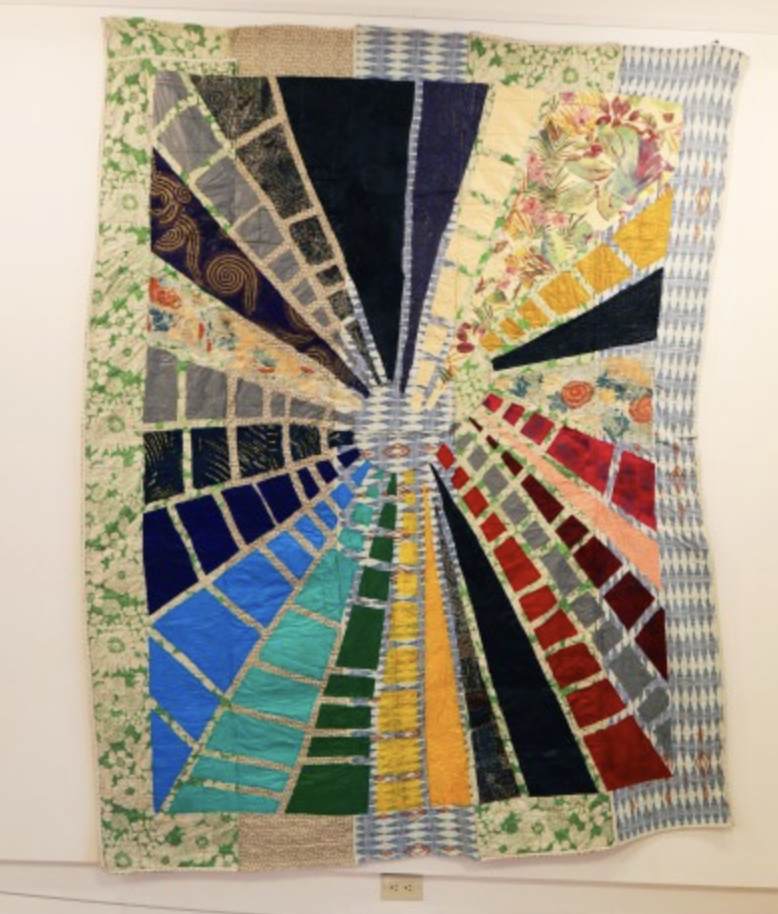
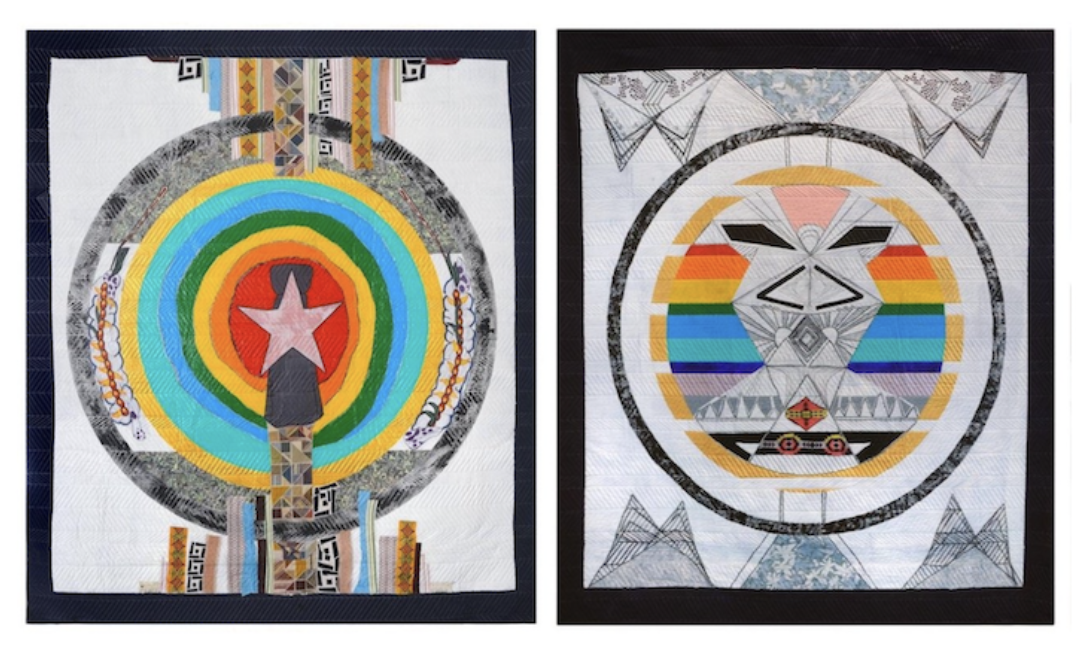
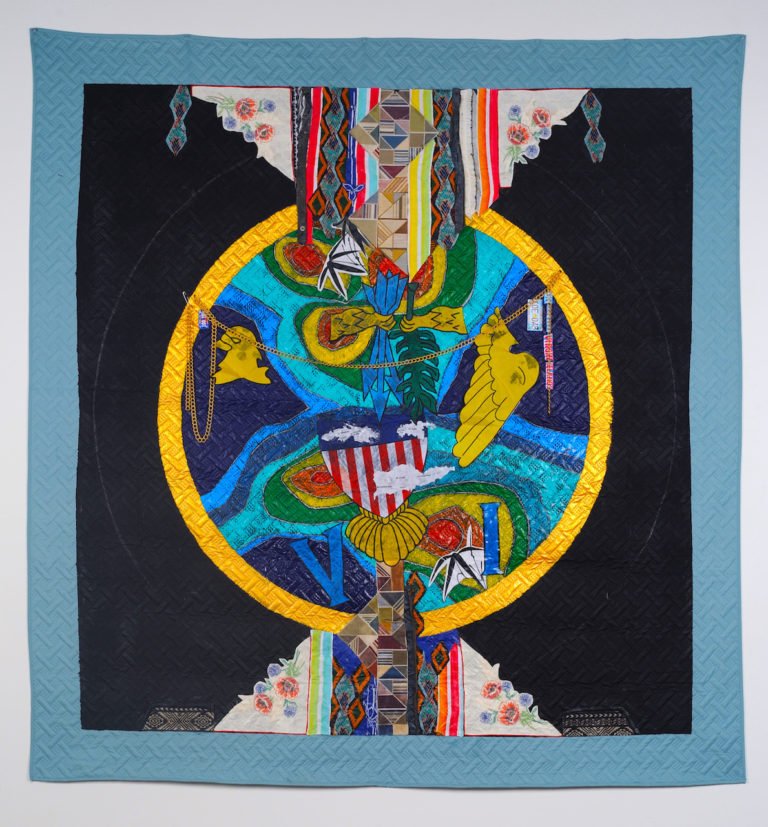
A native-born Puerto Rican with family from St. Thomas, St. John, Puerto Rico, Tortola and Antigua, Robles-Gordon created a visual discussion of the historical and political plight and resilience of the District of Columbia, where she resides, and the five U.S. territories that her two-sided quilts represent. They embody the artist’s creation of a political study of the territories and on the reverse side, a spiritual and cultural study.

Robles-Gordon’s early love of art and creativity moved her delight with fabrics, quilts and found objects to the discovery that these could and would be her artistic narrative.

A writer uses words to express; my medium of expression is my art, she said. “I use a myriad of materials according to what I’m trying to convey in a particular project or a particular narrative. It’s very essential that I match up with what I’m trying to convey,” Robles-Gorden said.

The decision to dismiss her native language, Spanish, came as a result of the teasing and ridicule Robles-Gordon experienced as a five-year-old kindergartener at her school in Arlington, Virginia, far away from her birthplace of Puerto Rico. She did not look like a Latina girl that was familiar to her classmates, and hence developed the bullying of this little brown-skinned girl.

In time, Robles-Gordon realized the importance of embracing her language and her culture and the need to find ways to heal through her research and employ it through her art as the medium on her journey to healing.

Speaking of her years as an artist, Robles-Gordon’s journey toward healing is what she brings creatively in her discoveries about U.S. Colonialism, “I think that it’s a beginning. There’s not an end to my journey. It’s a part of my journey. I think I’ve done a hell of a job in starting it. I actually feel proud about it in my own life. That feels good,” she said.

Robles-Gordon made the universe know how important this part of her journey is. “I think I’ve done that,” she said.

“Successions: Traversing U.S. Colonialism” exhibits the component of Robles-Gordon’s body of work containing six quilts embodying the Commonwealth of the District of Columbia, and the five U.S. territories of Guam, the U.S. Virgin Islands, Puerto Rico, the Northern Mariana Islands and American Samoa. The other component, “Place of Birth and Breath,” is the collage on canvas series created in 2020 and exhibited at the Universidad del Sagrado Corazon, (University of the Sacred Heart) in Puerto Rico.

“Place of Birth and Breath” is Robles-Gordon’s 10 mixed-media collage canvases that are a result of the visit with her mother to Puerto Rico where both women recaptured their roots, one of her childhood home, and the other of her birthplace.


“Isla del Encanto” collage, 18×24, 2020. (Courtesy of Amber Robles-Gordon)

A foundational symbology of the “Birth and Breath” body of work is the rubber tree that grows on the campus of the University of the Sacred Heart, which Robles-Gordon was introduced to while in Puerto Rico. “This tree appeared to be a literal fusion of past, present and future states of creation or sustaining an ecosystem. Throughout the series, are abstracted representations of the rubber tree – an entanglement of strong roots – as an example of its resiliency this tree most recently stood-fast to its native soil while 155 mph winds battered the campus,” Robles-Gordon noted.

Robles-Gordon shares her intricate ideas of how she layered her work depicting and interpreting the transitions of day to night and night to day. She relates to three major ethnic/racial groups – the Taino, the Spaniards and Africans, the stranglehold of the United States and the impact of the Caribbean Sea with its threat of hurricanes, scorching summer heat and lush landscapes.

Successions: Traversing U.S. Colonialism at American University exhibition closes on Dec. 12. The journey continues. The conversation continues. The healing continues.

See Amber Robles-Gordon’s website here..

Museums Review In the galleries: Artist’s works criss-cross the paths of U.S. colonialism

Museums Review In the galleries: Artist’s works criss-cross the paths of U.S. colonialism

Residents of D.C. are used to seeing the place as an almost-state, much like Maryland or Wyoming, yet not quite. Amber Robles-Gordon, a longtime Washingtonian who was born in Puerto Rico, has a different take. Her American University Museum show, “Successions: Traversing U.S. Colonialism,” groups D.C. with her birthplace and four other inhabited territories: Guam, the U.S. Virgin Islands, American Samoa and the Northern Mariana Islands. She represents these disenfranchised territories on two-sided quilted banners, one face for “political” and the other for “spiritual.”

Read More