People, food, and horticulture are among the things that move. Amber Robles-Gordon’s use of the Ficus Elastica is part of the symbology that reverberates throughout her exhibition, Successions: Traversing US Colonialism, on view at the American University Museum at the Katzen Arts Center in Washington, DC, through December 12, 2021. The Ficus Elastica—colloquially known as the rubber tree—has its roots in South Asia, though it was later nativized in the West Indies through the rubber trade. Dear reader, among your houseplants you are likely to find the genus of the rubber plant.
Read More
Museums Review In the galleries: Artist’s works criss-cross the paths of U.S. colonialism
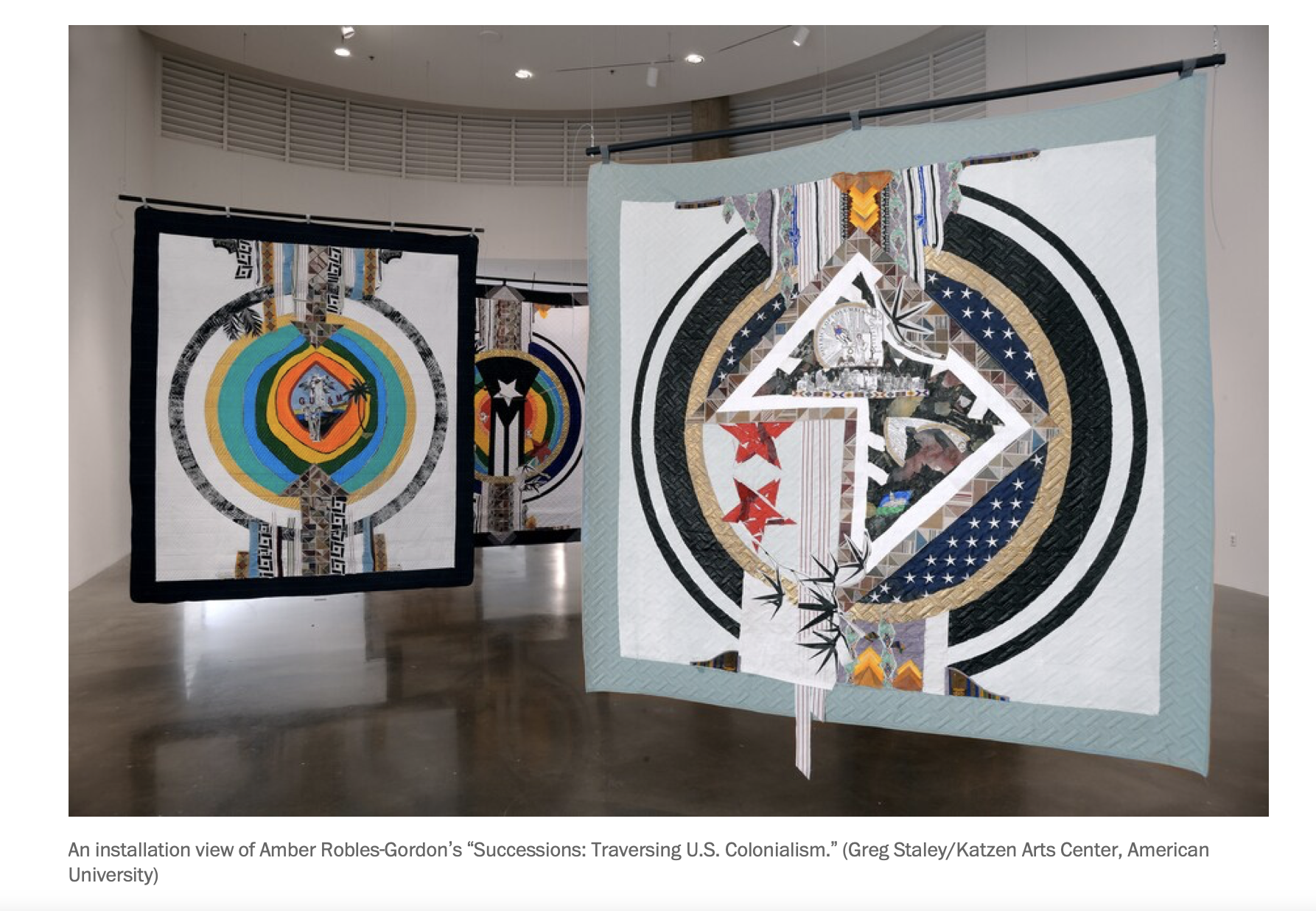
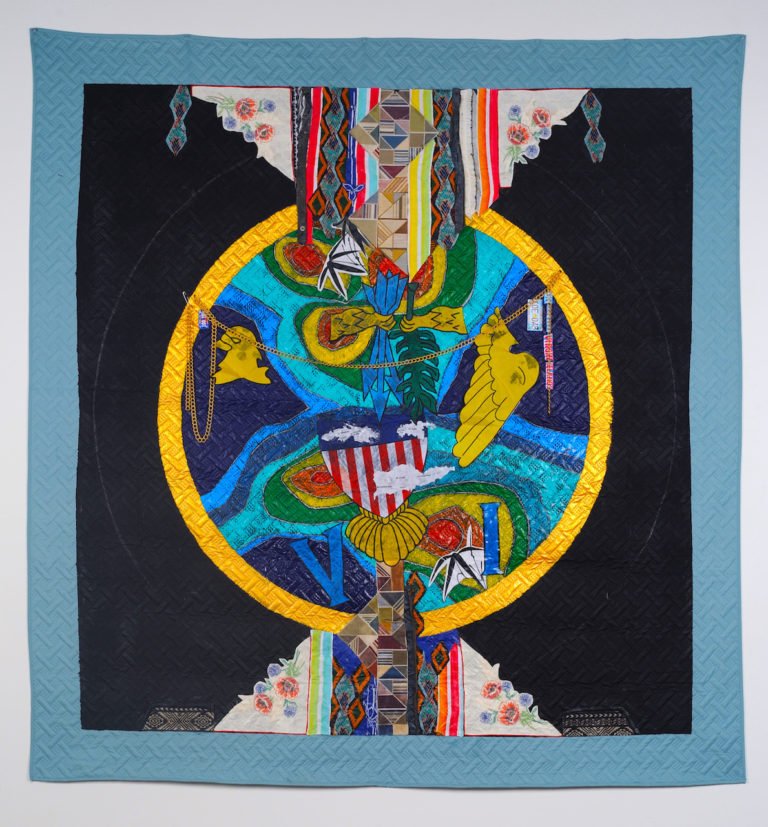
Residents of D.C. are used to seeing the place as an almost-state, much like Maryland or Wyoming, yet not quite. Amber Robles-Gordon, a longtime Washingtonian who was born in Puerto Rico, has a different take. Her American University Museum show, “Successions: Traversing U.S. Colonialism,” groups D.C. with her birthplace and four other inhabited territories: Guam, the U.S. Virgin Islands, American Samoa and the Northern Mariana Islands. She represents these disenfranchised territories on two-sided quilted banners, one face for “political” and the other for “spiritual.”
Read MoreExamining Black Existentialism through the Curatorial Lens
Join our panelists as they journey through texts by Octavia Butler and bell Hooks, Parable of the Sower and Salvation: Black People and Love. They will explore and discuss parallels and intersections between themes posited in these seminal texts and their own individual curatorial/artistic practices.
Read MoreWeaving Identity: A Conversation on Textile Practice in the 21 st Century
This panel explores the power of contemporary visual art through the practices of the Diaspora’s most preeminent artists who innovate through the use of textiles. The panel will also share how their works are impacted by black existential thought. Followed by Cocktails and Light Bites Vranken Pommery and Red Rooster.
Read More
Successions: Traversing US Colonialism Listed on BmoreArt’s Picks: November 2-8
This Week: John Oliver’s hand-picked AVAM exhibition, A Passion for Collecting: The Vision of Louis Allan Ford at Galerie Myrtis, Zoë Charlton in conversation presented by Cade Gallery, Bridget Z. Sullivan at Hamilton Gallery, Jonna McKone/Keep A-Knockin’/Noah Breuer/Solo Lab 5 opening at VisArts, Amber Robles-Gordon at the Katzen Art Center, Katie Pumphrey: Night Swim at Project 1628, The Guardians presented by the Peale at Carroll Mansion, and more … plus Maryland Art Place UNDER $500 2021 and other featured calls for entry.
Read More
Amber Robles-Gordon's Artwork Navigates US Colonialism for its Colonies, including DC
in Event
About this event
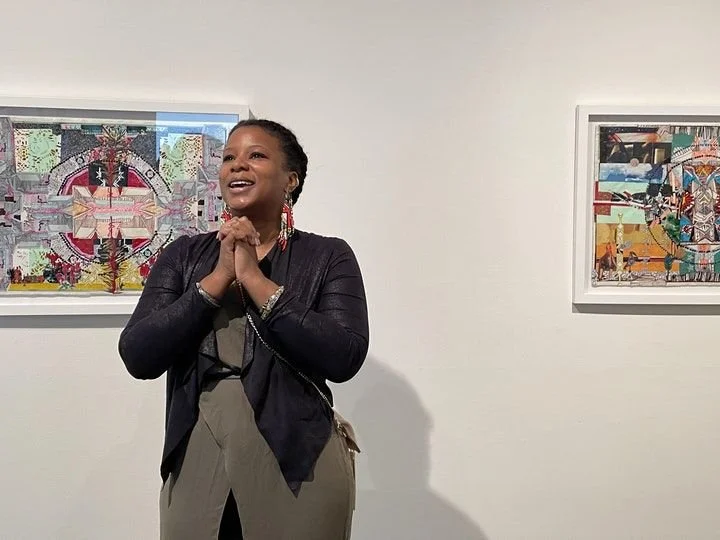
Millennium Arts Salon provides this salon talk featuring Artist Amber Robles-Gordon in interview with Interim Chief Curator of the National Museum of African American History and Culture, Dr. Tuliza Fleming, at the Katzen Arts Center of American University. Ms. Robles-Gordon, who was born in Puerto Rico, and raised in the DC area, examines the role of the United States as a colonial power with both Puerto Rico and the District of Columbia as two such colonies, with intimations of paternalism, tyranny, and containment of citizen aspiration attendant thereto. Dr. Fleming as scholar, will guide our better understanding of Amber's magnum opus, as she explores the underpinnings of the artwork from conceptualization to execution.
Millennium Arts Salon honors our relationship with the Katzen Arts Center in bringing programs of importance to our joint and several audiences in their beautiful and monumental space.
The MAS Salon Talk will be delivered over Zoom. Please register via the Eventbrite ticket engine and an email of the Zoom link will be sent to you before the event.
Please join us Saturday November 13 at 3:00 pm
Artfully yours,
The Board of Directors of Millennium Arts Salon
Trinity Talks with Artist Amber Robles-Gordon
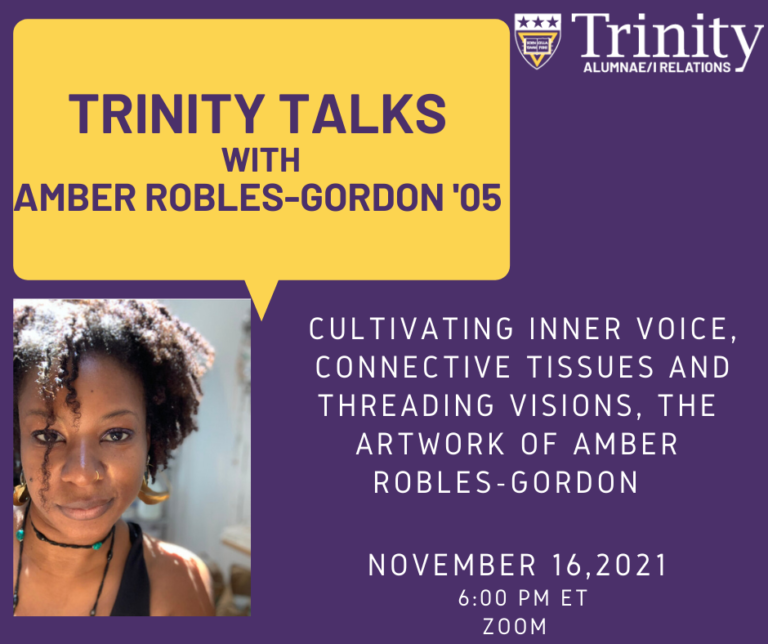
Join the Office of Alumnae/i Relations for Trinity Talks with Amber Robles-Gordon ’05, Cultivating Inner Voice, Connective Tissues and Threading Visions, the Artwork of Amber Robles-Gordon on Tuesday, November 16, 2021 at 6:00 pm ET via Zoom.
Join Amber for an artist talk that focuses on following and cultivating a relationship with one’s inner voice and how that has directed her path thus far. She will highlight projects that exemplify this premise and how that lead to her first solo exhibit featured at American University.
Read MoreREVIEW: A deeper look into two AU Museum art exhibits
‘The Art of Reimagining Scientific Discovery’ and ‘Traversing US Colonialism’ bring spectators into new perspectives
By Olivia Barclay / Monday, October 25, 2021
The American University Museum at the Katzen Arts Center opened in August and currently features five exhibits, all with very different themes.
The museum features a variety of exhibits every season that open viewers up to a whole new world of art. “Reveal: The Art of Reimagining Scientific Discovery” and “Successions: Traversing US Colonialism” are two of the exhibits that introduce viewers to new perspectives on the world we live in today.
“The Art of Reimagining Scientific Discovery” by Rebecca Kamen
“Reveal: The Art of Reimagining Scientific Discovery” by Rebecca Kamen uses a mixture of models and paintings. Kamen focuses on rocks, cells, cell processes and viruses in her exhibit.
The rock models are made out of mylar and are painted with acrylic paint, making the viewer look at different types of rocks in a new way. By making these models colorful, Kamen hopes to demonstrate the importance of rocks in an interesting way.
She also includes cell processes such as cell division in her pieces titled “Warming.” “Warming” is painted on mylar with washes of bright colors. Creating these pieces introduces viewers to the beauty of cells and how amazing the human body is in the ability to conduct such processes.
Kamen also made several models of the coronavirus out of mylar and painted with acrylic paint. She produced these pieces to pay tribute to the losses from the virus and the relevance it has in all of our lives. She also demonstrates the complexity in the structure of the virus through the accurately placed features and bright layers of orange. Kamen encapsulates the beauty of science and the importance it has on all of our lives. “The Art of Reimagining Scientific Discovery” honors how far science has come in the past years and educates audiences on just how much we know about science.
“Traversing US Colonialism” by Amber Robles-Gordon
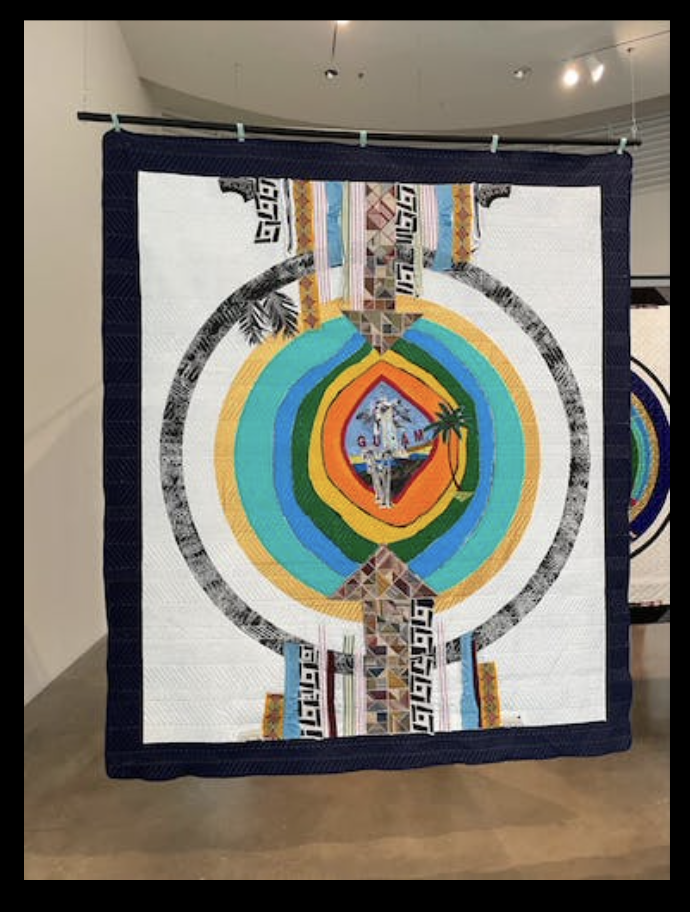
“Traversing US Colonialism” is an exhibit created by Amber Robles-Gordon. It is a mixture of quilts and collages that detail the United States’ history of colonization. In her quilts, she depicts some of the territories the U.S. has invaded and the effects it's had on the people living in those areas.
Robles-Gordon’s quilts demonstrate how U.S. colonization has specifically affected people in those territories spiritually and politically. Each side of the seven quilts depicts these effects in order to demonstrate just how much damage was done as a result. The quilts intend to make the viewer think about the actions of their country in the past and how that is prevalent in the future. To the viewer, she wants her audience to question the effects of colonization on the people, not just the benefits of their country.
Robles-Gordon's exhibit also includes her own story in it, incorporating her birthplace of Puerto Rico. This portion of the exhibit is titled “Place of Breath and Birth,” which includes collages displayed on canvas. Here, she brings to light the debate of statehood for her birthplace as well as the effects that the pandemic had on Puerto Rico. Robles-Gordon intends to educate her audience on how U.S. territories, specifically Puerto Rico, are directly affected by the United States’ actions. Robles-Gordon highlights the lack of support that the country has given to Puerto Rico and how that has been similar for the other territories under U.S. control. Amber Robles-Gordon demonstrates how US colonialism affects the people within those territories and specifically how it affected her own country.
The AU Museum brings to light many different perspectives on the world we live in today. “The Art of Reimagining Scientific Discovery” and “Traversing US Colonialism” will help students and residents better understand the advancements and tribulations of the nation to better engage in the environment around them.
https://www.theeagleonline.com/article/2021/10/review-a-deeper-look-into-two-au-museum-art-exhibits
Of the Place, An American University, MFA Studio Art Program Sponsored Conversation
The MFA Studio Art program at American University is pleased to present
Of the Place, a series of conversations that center the artists, art organizations, art activators, and culture producers who have deep connections to their locale.
The theme reflects the times that we are living in – many of us have had to stay in place over the last year. The global pandemic, politics, and the cultural circumstances of our contemporary world have necessitated a change in our social and work patterns. We are looking within our own communities to share resources and support.
Read MoreGallery Talk: "Successions: Traversing US Colonialism"

C Artist Amber Robles-Gordon talks "Successions: Traversing US Colonialism" with curator Larry Ossei-Mensah. . "Successions" is a conceptual juxtaposition that celebrates abstraction as an art form while leveraging it as a tool to interrogate past and current US policies within its federal district (Washington, DC) and territories (including Guam, Puerto Rico, and the US Virgin Islands) that it controls. . On view through December 12, 2021. Learn more and plan your visit:
https://www.american.edu/cas/museum/2021/successions.cfm
Read More
American University Museum at the Katzen Arts Center opens fall exhibitions
Successions: Traversing U.S. Colonialism is a solo exhibition by Amber Robles-Gordon, a conceptual juxtaposition celebrating abstraction as an art form. Robles-Gordon interrogates past and current U.S. policies within Washington, D.C. and the territories (Guam, Puerto Rico and the U.S. Virgin Islands) that it controls…
Read More
From California to Chicago, Tennessee to Maine, 15 of Summer’s Best Museum Exhibitions Remain on View This Fall
A BROAD SELECTION of exhibitions opened at art museums throughout the United States over the summer months. A great number of these shows remain on view, some through September, others further into the fall and beyond. Major traveling exhibitions of Bob Thompson, Joseph Yoakum, and Alma Thomas are underway. The first solo museum exhibitions of Caroline Kent and Simphiwe Ndzube are debuting in Chicago and Denver, while the first survey exhibitions of Jamal Cyrus and Jacolby Satterwhite are on view in Houston and Pittsburgh. Jennifer Packer and Cauline Smith have shows, too. In Nashville, a major retrospective of legendary sculptor William Edmondson is being staged, the first such presentation in two decades:
Read More
Gallery Talk for Successions: Traversing US Colonialism
Gallery Talk: "Successions"
DC mixed-media artist Amber Robles-Gordon talks "Successions" with curator Larry Ossei-Mensah.
About this Event:
Successions is a conceptual juxtaposition that celebrates abstraction as an art form while leveraging it as a tool to interrogate past and current US policies within its federal district (Washington, DC) and territories (including Guam, Puerto Rico, and the US Virgin Islands) that it controls.
This event will be held virtually. Please register to receive the Zoom link via email. Learn more about the exhibition.
OrganizerAmerican University Museum At The Katzen Arts Center
Organizer of Gallery Talk: "Successions"
Housed in the dynamic and multidisciplinary Katzen Arts Center, the American University Museum builds its programming on the strengths of a great college and great university. We focus on international art because American University has a global commitment. We show political art because the university is committed to human rights, social justice, and political engagement. We support the artists in our community because the university takes an active and responsible role in the formation of our contemporary art and culture.
We present exhibitions that mirror American University’s aspiration to be the premier Washington-based, global university. Our programming puts the best art of our region in a national and international context. Our collections enable us to present the art history of Washington, while our Kunsthalle attitude brings the most provocative art of our time to our place.
You may also like the following events from American University Museum at the Katzen Arts Center:
Next month, 12th October, 06:00 pm, Gallery Talk: "Seeing Climate Change"
Next month, 14th October, 06:00 pm, Gallery Talk: "Reveal" in Online
This November, 17th November, 06:00 pm, Gallery Talk: “In the Light of Memory” in Online
Also check out other Arts Events in Online,Exhibitions in Online.
Ticket Information: RSVP
Tickets for Gallery Talk: "Successions" can be booked below.
https://www.eventbrite.com/e/gallery-talk-successions-tickets-163405503259
Ticket Price: Free
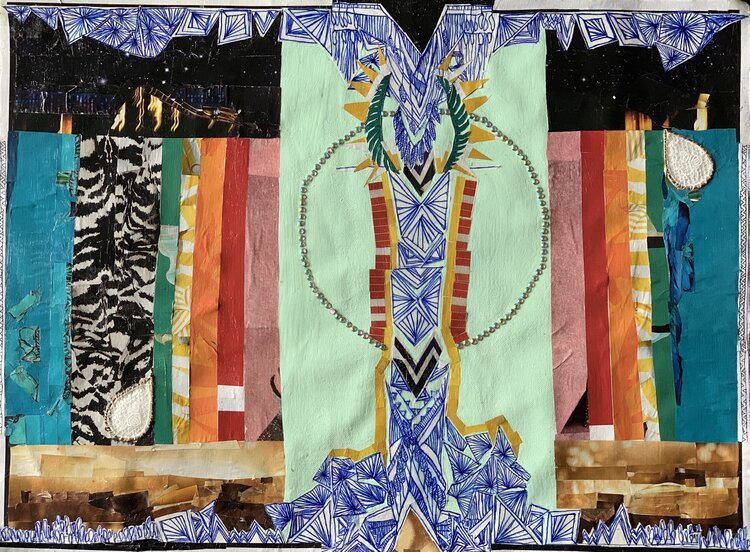
Image: Amber Robles-Gordon, y mi bandera vuela mas alto que la tuya (detail), 2020. Mixed media collage on canvas, 18 x 24 in. Courtesy of the artist.

Successions: Traversing US Colonialism Amber Robles-Gordon
August 28–December 12, 2021
American University Museum Curated by
at the Katzen Arts Center Larry Ossei-Mensah
Amber Robles-Gordon presents Successions: Traversing US Colonial- ism, a solo exhibition on view at the American University Museum at the Katzen Arts Center in fall 2021. Successions is a conceptual juxta- position that celebrates abstraction as an art form while leveraging it as a tool to interrogate past and current US policies within its federal district (Washington, DC) and territories (including Guam, Puerto Rico, and the US Virgin Islands) that it controls. By highlighting nuances relat- ed to US governance in its federal districts and territories, Robles-Gor- don seeks to question who has access to resources, citizenship, and the right to sovereignty.
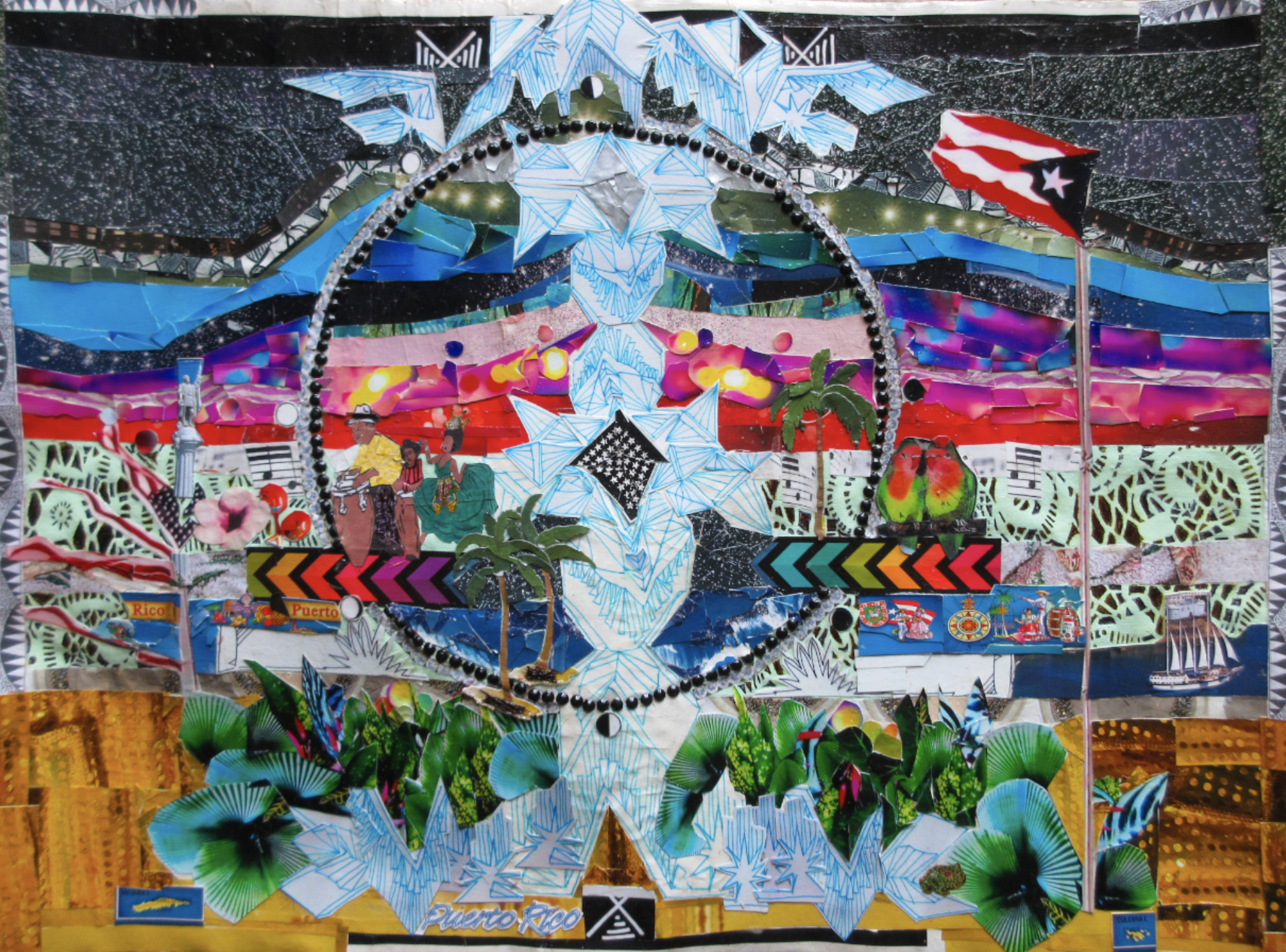
y mi bandera vuela mas alto que la tuya., Mixed Media Collage on Canvas, 18 x 24 in., 2020
Robles-Gordon creates artwork imbued with a layered visual language replete with cultural signifiers and abstract gestures. Successions is a celebration of abstraction as an artistic expression. Robles-Gordon uti- lizes iconic artists like Robert Rauschenberg, Alma Thomas, Romare Bearden, and members of the Washington Color School as vivid refer- ence points for her own dynamic use of color, form, and material within the works she created for the exhibition. These explorations will provide insights into a number of inquiries that undergird the construction of the exhibition. Successions creates a pathway towards discursive crit- icism around issues impacting marginalized communities oppressed by the United States’ hegemonic domestic and foreign policies. The exhibition features a new body of colorful abstract paintings, collages, and quilts created in 2020 and 2021 between San Juan, Puerto Rico (Robles-Gordon’s birthplace) and Washington, DC (where she current- ly lives).
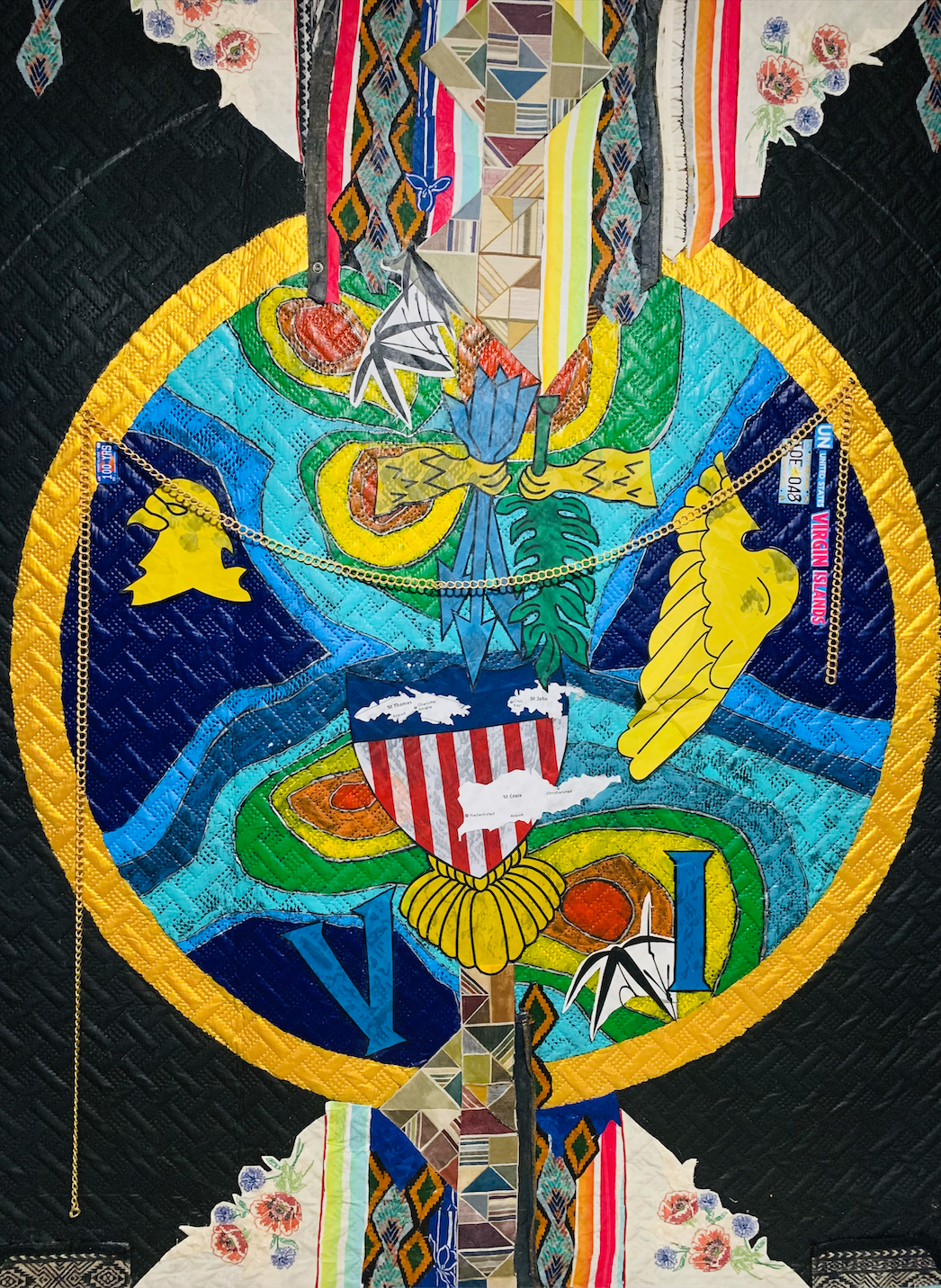
USVI Political, Detail, Front, Mixed Media on Quilt, 86 in. x 90 in., in., 2021
During the height of the COVID-19 pandemic, Robles-Gordon’s creative strategies were directly impacted as a result of sheltering in place in San Juan. The lack of access to materials and arduous circumstances she was confronted with in Puerto Rico and upon returning to Washington, DC catalyzed Robles-Gordon to impro- vise her approach to making works for the exhibition. Moreover, the ex- perience heightened her awareness of how communities on the margin are adversely treated during mo- ments of crisis.
Robles-Gordon’s also uses works featured in Successions to mine the stories, personal narratives, and aesthetics of the women of the Caribbean, particularly of African de- scent, in an effort to investigate the political, socio-economic, and envi- ronmental implications of placemaking, contemporary colonial policy, and notions of citizenship on these social groups. The debate over DC statehood, similar to Puerto Rico, has been a prevalent point of con- tention in the District but rarely featured in the national conversation. Robles-Gordon seeks to use her “backyard” as a metaphor that would
expand our understanding of notions of freedom, liberty, and justice.
A fully illustrated catalog with essays by Ossei-Mensah and Noel Anderson and in-person and virtual programs will accompany the exhibi- tion, enriching the viewer’s experience.
In Shoulder the Deed, Artists Reflect on the Present and the Past
in Event
In the exhibition Shoulder the Deed at Eckington gallery STABLE, the curators have gone back and fetched a history that strengthens the establishment not only of STABLE, but also of the Black artists living and working in D.C.
by SHANTAY ROBINSON JULY 15TH, 2021
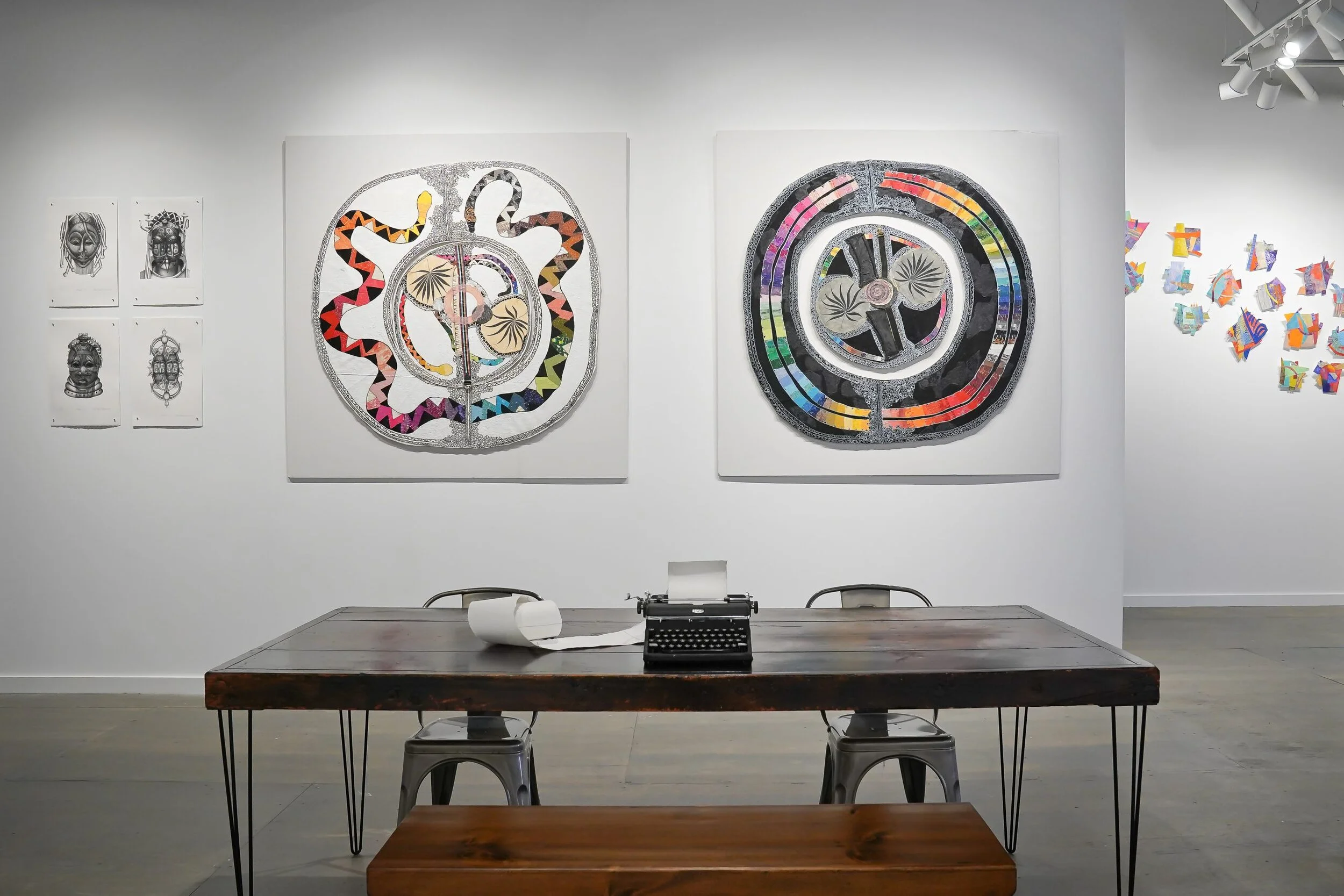
Photography courtesy of Tony Powell.
Image Description:
(center) Starr Page.‘The’ James Baldwin Table, 2018.
(bottom center) Amber Robles Gordon The Male, The Architect, The Protector (Outer Circle) The Universe (inner circle), 2017, The Female, The Oracle, The Nurturer, (outer circle), 2017.
(left) Gail Shaw-Clemons,. Masks, 2020.
(right) Aziza Gibson-Hunter, Gri Gris, for the First Wave of the Third Millennium, 2020.
Originating from the Akan people of Ghana, the term Sankofa is often associated with the proverb “Se wo were fi na wosankofa a yenkyi,” meaning “it is not taboo to go back and fetch what you forgot.” The Adinkra symbol for the concept is a mythical bird flying forward with its head turned backward. In the exhibition Shoulder the Deed at Eckington gallery STABLE, the curators have gone back and fetched a history that strengthens the establishment not only of STABLE, but also of the Black artists living and working in D.C. STABLE, in collaboration with the Black Artists of D.C., presents an impressive collection of artworks steeped in rich African and African American traditions. As you enter the space, the wall to the right features photographs of some key personages such as Harlee Little and Juliette Madison, who, beginning in 1985, envisioned a space where Black photographers could commiserate and work. Shoulder the Deed is a spiritual reckoning. The artists in the exhibition, spanning several generations, come together to travel through time to bring forth conceptual and even modern works that speak to Black experience through portraiture, video art, assemblage, and more.
Before seeing the artwork, Black presence is felt and sets the tone for the exhibition. Upon entering the gallery, the sounds from Shaunté Gates’ video work “Free Breakfast Program” hauntingly quiets the mind. The repetitive loop of phrases such as “By their very presence…” and “I was always here …” over a go-go rhythm signals that we are in Black space, if the artworks had not already signaled this. The sound draws you to the work full of edited and manipulated images, displaying a history of the Black experience. The archival historical footage is juxtaposed with more recent archival footage as Black people perform traditional African dance and B-boys break.
While Gates’ work references relatively recent history using media technology, Gina Marie Lewis confronts history with an ancestral altar. “Libations for the Journey” is a mixed media work that uses images, cowrie shells, bottle corks, seashells, champagne, and door handles to offer the ancestors access and vision on a journey. A wooden box depicting a slightly open door sits in the middle of the altar as a doorway to the past, with candles inside to light the way in the darkness. This generous offering to the ancestors allows the artist to look to the past to create a path to the future spiritually. Lewis uses traditional technology to reach back in time to secure the blessings of the ancestors on a journey forward.
In keeping with the theme of looking at the past, Stan Squirewell’s “Monk Hancock (Innocent Criminal Series)” combines ancient times with the present in a portrait that is a mashup of a modern-day Black man dressed in a black winter coat manipulated with an overlay of the facade of an Egyptian statue and the bodice of a Roman one. Looking back to notable periods in history, Squirewell tells a contemporary story about the fight for survival. The portrait allows for a connection between how a contemporary Black man must fight for his life, much like those who have gone before in other treacherous times.
Nekisha Durrett’s “Magnolias” says the names of women whose lives were lost too soon. In a light box, the names of three women are highlighted on magnolia leaves. These unarmed women were killed by police, referencing the threat unarmed Black women face in their everyday existences. The stories of these women’s deaths are all too common today, but by saying their names, Durrett remembers them and encapsulates their circumstance for others to know and remember their fates.
The artworks in the exhibition work together; Michael Platt’s “Evening Ritual,” a painting of a nude Black woman depicted eight times and composed in a circle, alludes to the “magic” that Black women have been known to perform for centuries. The subject of the painting looks directly at the viewer from many angles as we witness her in ritual. The idea reminds viewers of the spectatorship Black people have gone through as the “other.” The defiance in the subject’s response shows she is not threatened by the gaze of the viewer.
In several ways, the artworks speak of the present while at the same time referring to the past. From modernist tendencies to conceptual leanings, the show represents an array of works that belong in the same exhibition space but are each unique in their perspective. As a continuation of STABLE’s relationship with Black artists for almost four decades, this exhibition represents the importance of looking back to the foundation for clues on the direction to take next. Each of the artworks in Shoulder the Deed has a distinct quality that makes visitors want to see more from the artists. The artwork in this exhibition looks at the past while representing the contemporary moment, moving us into a more conscious future.
At STABLE to Sept. 30. 336 Randolph Place NE. (202) 953-9559. stablearts.org.
This story has been updated to clarify Little and Madison’s connection to STABLE.
Successions: Traversing US Colonialism @ American University Museum at the Katzen Arts Center
Amber Robles-Gordon
Curated by Larry Ossei-Mensah
August 29–December 12, 2021
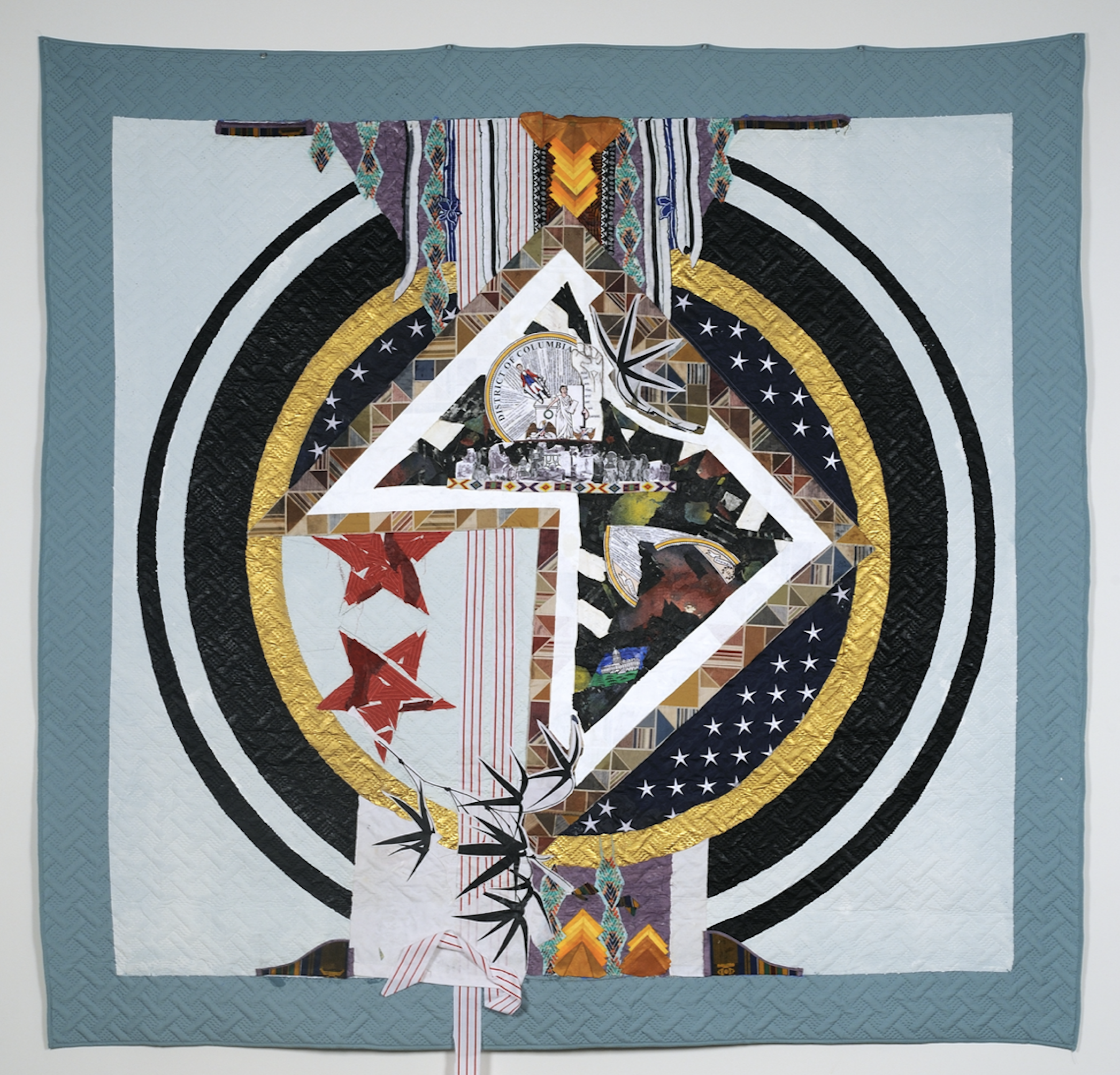
DC Political, Welcome to the District of Colonialism, Front, Mixed Media on Quilt, 86 (L) in. x 90 (H) in., 2021
Amber Robles-Gordon presents Successions: Traversing US Colonialism, a solo exhibition on view at the American University Museum at the Katzen Arts Center in fall 2021. Successions is a conceptual juxtaposition that celebrates abstraction as an art form while leveraging it as a tool to interrogate past and current US policies within its federal district (Washington, DC) and territories (including Guam, Puerto Rico, and the US Virgin Islands) that it controls. By highlighting nuances related to US governance in its federal districts and territories, Robles-Gordon seeks to question who has access to resources, citizenship, and the right to sovereignty.
Robles-Gordon creates artwork imbued with a layered visual language replete with cultural signifiers and abstract gestures. Successions is a celebration of abstraction as an artistic expression. Robles-Gordon utilizes iconic artists like Robert Rauschenberg, Alma Thomas, Romare Bearden, and members of the Washington Color School as vivid reference points for her own dynamic use of color, form, and material within the works she created for the exhibition. These explorations will provide insights into a number of inquiries that undergird the construction of the exhibition. Successions creates a pathway towards discursive criticism around issues impacting marginalized communities oppressed by the United States’ hegemonic domestic and foreign policies. The exhibition features a new body of colorful abstract paintings, collages, and quilts created in 2020 and 2021 between San Juan, Puerto Rico (Robles-Gordon’s birthplace) and Washington, DC (where she currently lives).
During the height of the COVID-19 pandemic, Robles-Gordon’s creative strategies were directly impacted as a result of sheltering in place in San Juan. The lack of access to materials and arduous circumstances she was confronted with in Puerto Rico and upon returning to Washington, DC catalyzed Robles-Gordon to improvise her approach to making works for the exhibition. Moreover, the experience heightened her awareness of how communities on the margin are adversely treated during moments of crisis.
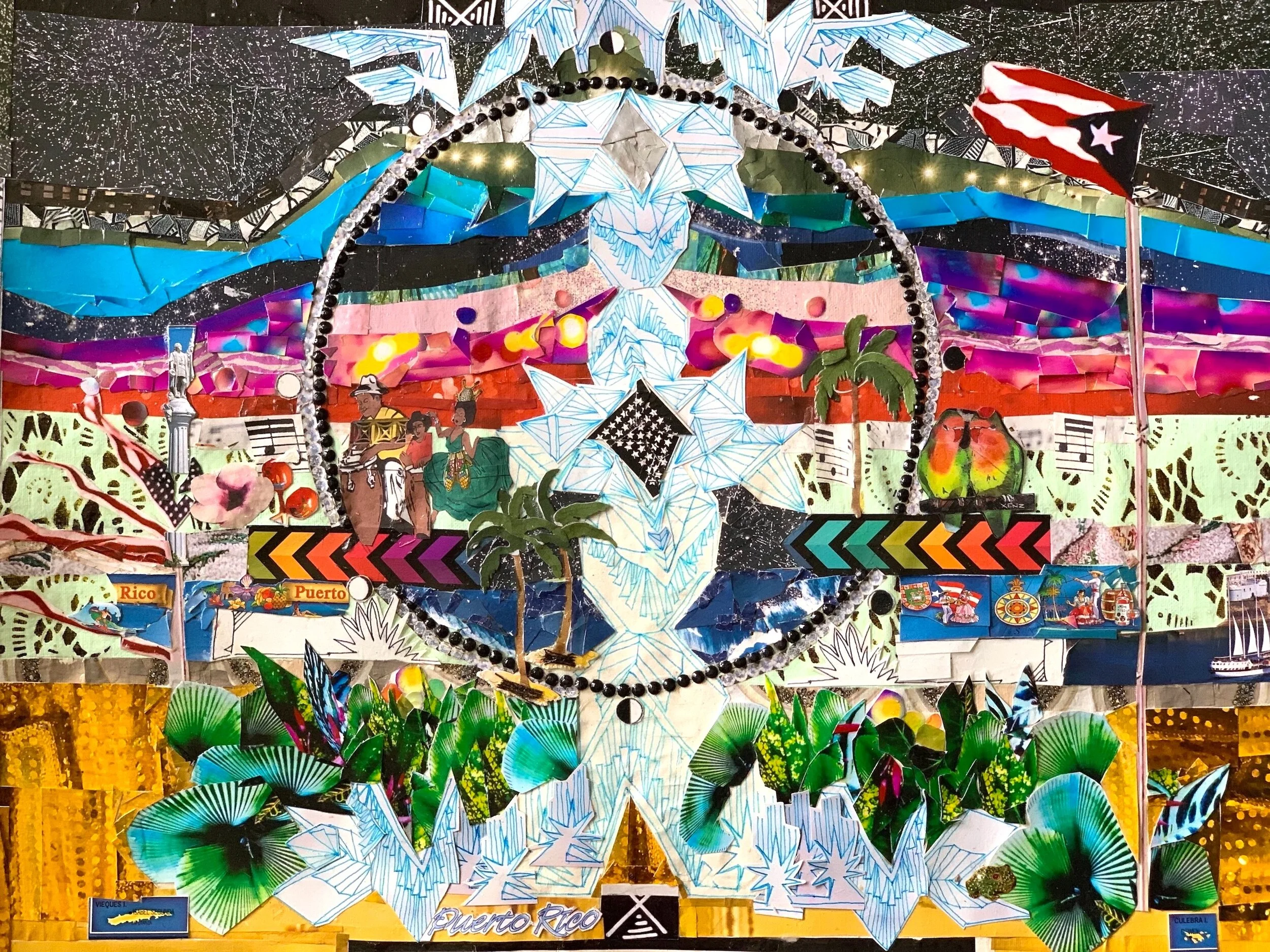
y mi bandera vuela mas alto que la tuya, 2020. Mixed media collage on canvas, 18 x 24 in. Courtesy of the artist.
Robles-Gordon’s also uses works featured in Successions to mine the stories, personal narratives, and aesthetics of the women of the Caribbean, particularly of African descent in an effort to investigate the political, socio-economic, and environmental implications of placemaking, contemporary colonial policy, and notions of citizenship on these social groups. The debate over DC statehood, similar to Puerto Rico, has been a prevalent point of contention in the District but rarely featured in the national conversation. Robles-Gordon seeks to use her “backyard” as a metaphor that would expand our understanding of notions of freedom, liberty, and justice.
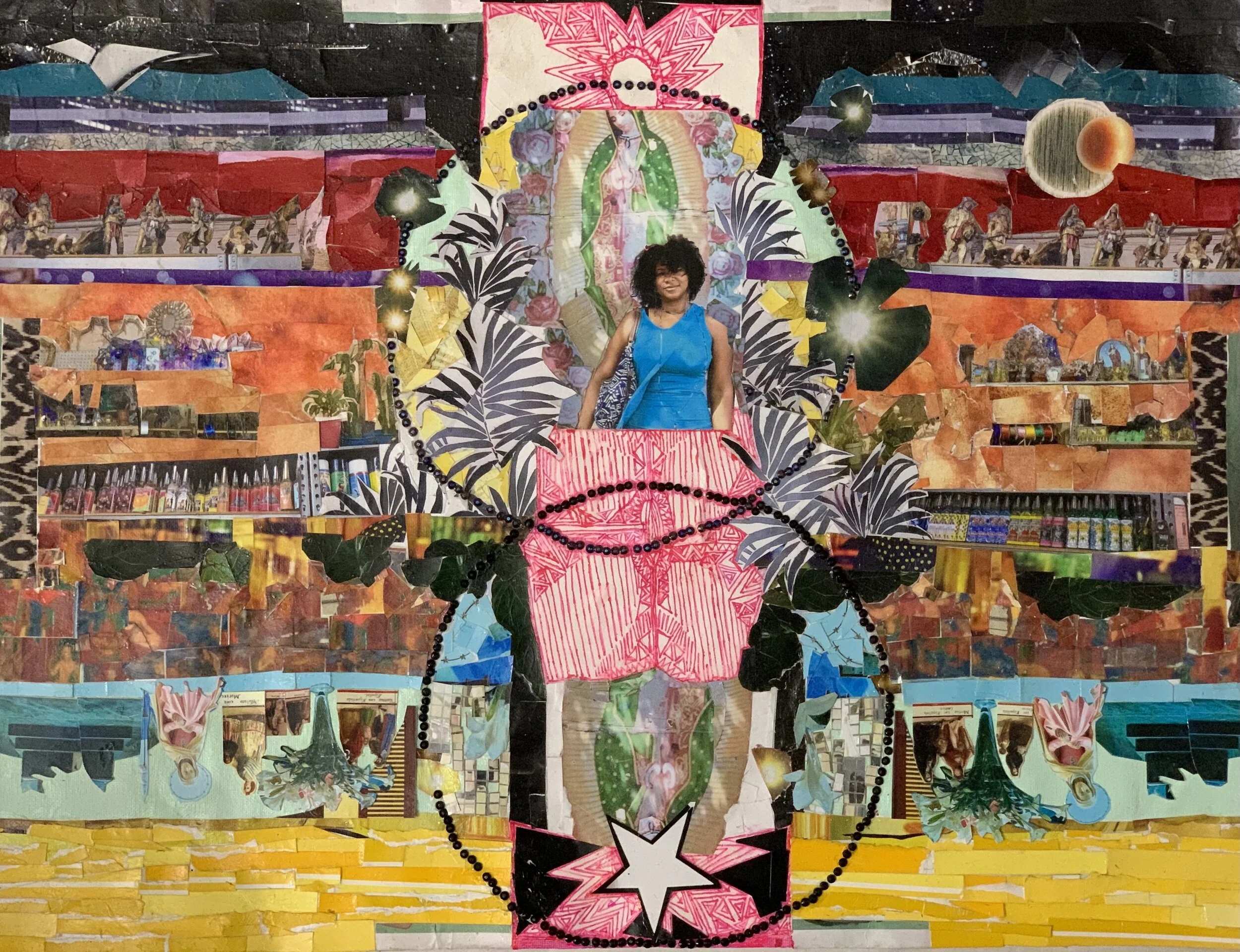
Reflexiones sobre el yo, la virgen maría y el colonialismo, (Reflections of Self, The Virgin Mary and Colonialism,) Mixed media, collage on canvas, 18 x 24 in. Courtesy of the artist.
A fully illustrated catalog with essays by Ossei-Mensah and Noel Anderson and in-person and virtual programs will accompany the exhibition, enriching the viewer’s experience.
Click the link below for additional information and artwork included in the exhibition.
https://www.american.edu/cas/museum/2021/successions.cfm
About the Artist:
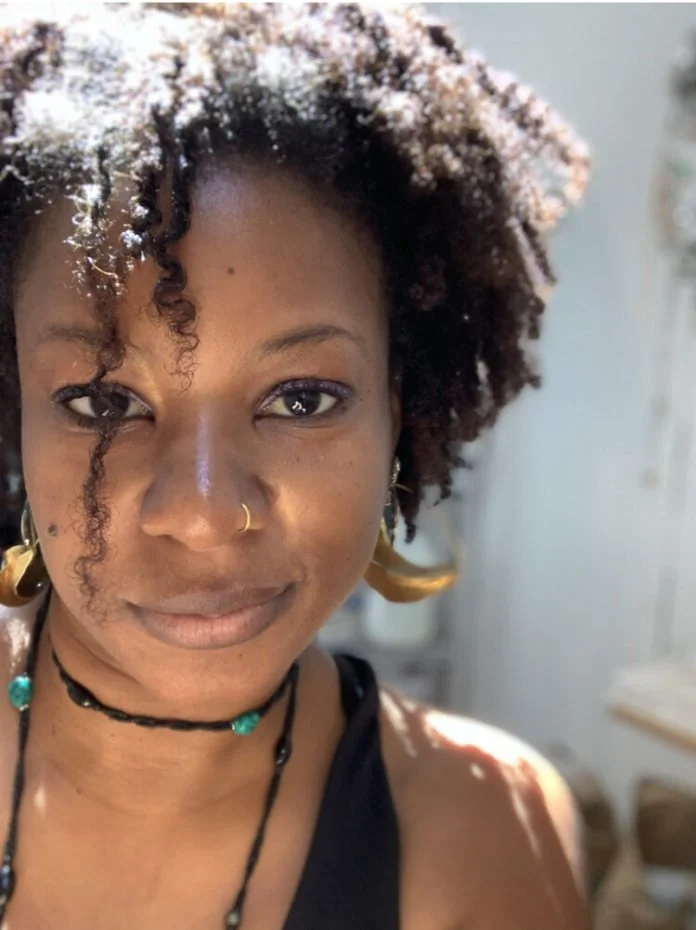
Amber Robles-Gordon is a mixed media visual artist of Puerto Rican and West Indian heritage. She is known for her commissioned temporary and permanent public art installations for numerous government agencies, institutions, universities, and art fairs.
Robles-Gordon has over twenty years of experience exhibiting and in art education, commissioned critiques, lectures, teaching, and exhibition coordination. She received a BS in business administration from Trinity University and an MFA in painting from Howard University, Washington, DC. She has exhibited nationally and internationally, including Germany, Italy, Malaysia, England, and Spain. Robles-Gordon has participated in residencies in Costa Rica, Washington, DC, and at the American Academy in Rome, Italy. Her artwork has been reviewed and featured in numerous magazines, journals, newspapers, and online publications.
Most recently, she held an online solo exhibition at Galeria de Arte, Universidad del Sagrado Corazón, San Juan, Puerto Rico, and was featured by Tafeta Gallery in the 1-54 Contemporary African Art Fair in London, England, and during London Art Week. In 2022, she will create a traveling exhibition in collaboration with Cultural DC and El Cuadrado Gris Galeria in Puerto Rico.
About the Curator:
Larry Ossei-Mensah uses contemporary art as a vehicle to redefine how we see ourselves and the world around us. A Ghanaian-American curator and cultural critic, Ossei-Mensah has organized exhibitions and programs at commercial and nonprofit spaces around the globe from New York City to Rome, featuring artists including Firelei Baez, Allison Janae Hamilton, Brendan Fernades, Ebony G. Patterson, Modou Dieng, Glenn Kaino, Joiri Minaya and Stanley Whitney. Moreover, Ossei-Mensah has actively documented cultural happenings featuring the most dynamic visual artists working today, including Derrick Adams, Mickalene Thomas, Njideka Akunyili Crosby, Federico Solmi, and Kehinde Wiley.
A native of The Bronx, Ossei-Mensah is also the co-founder of ARTNOIR, a 501(c)(3) and global collective of culturalists who design multimodal experiences aimed to engage this generation’s dynamic and diverse creative class. ARTNOIR endeavors to celebrate the artistry and creativity of Black and Brown artists around the world via virtual and in-person experiences. Ossei-Mensah was a contributor to the first-ever Ghanaian Pavilion for the 2019 Venice Biennial with an essay on the work of visual artist Lynette Yiadom-Boakye.
Ossei-Mensah is the former Susanne Feld Hilberry Senior Curator at MOCAD in Detroit and currently serves as Curator-at-Large at Brooklyn Academy of Music (BAM), where he curated the New York Times heralded exhibition Let Free Ring and A Return: Liberation as Power respectively.
Ossei-Mensah has been profiled in publications including the New York Times, Artsy, and Cultured Magazine, and was recently named to Artnet’s 2020 Innovator List. Follow him on Instagram at @larryosseimensah and Twitter at @youngglobal.

Art in Embassies Program: 3 Questions Digital Series with Amber Robles-Gordon →
An interview from Art in Embassies 3 Questions Digital Series with Amber Robles-Gordon, who speaks about her creative process and artwork at the U.S. Ambassador’s residence in Abuja, Nigeria.
Read More