“Imagining a World Creates It”: Amber Robles-Gordon Interviewed by Jessica Lanay

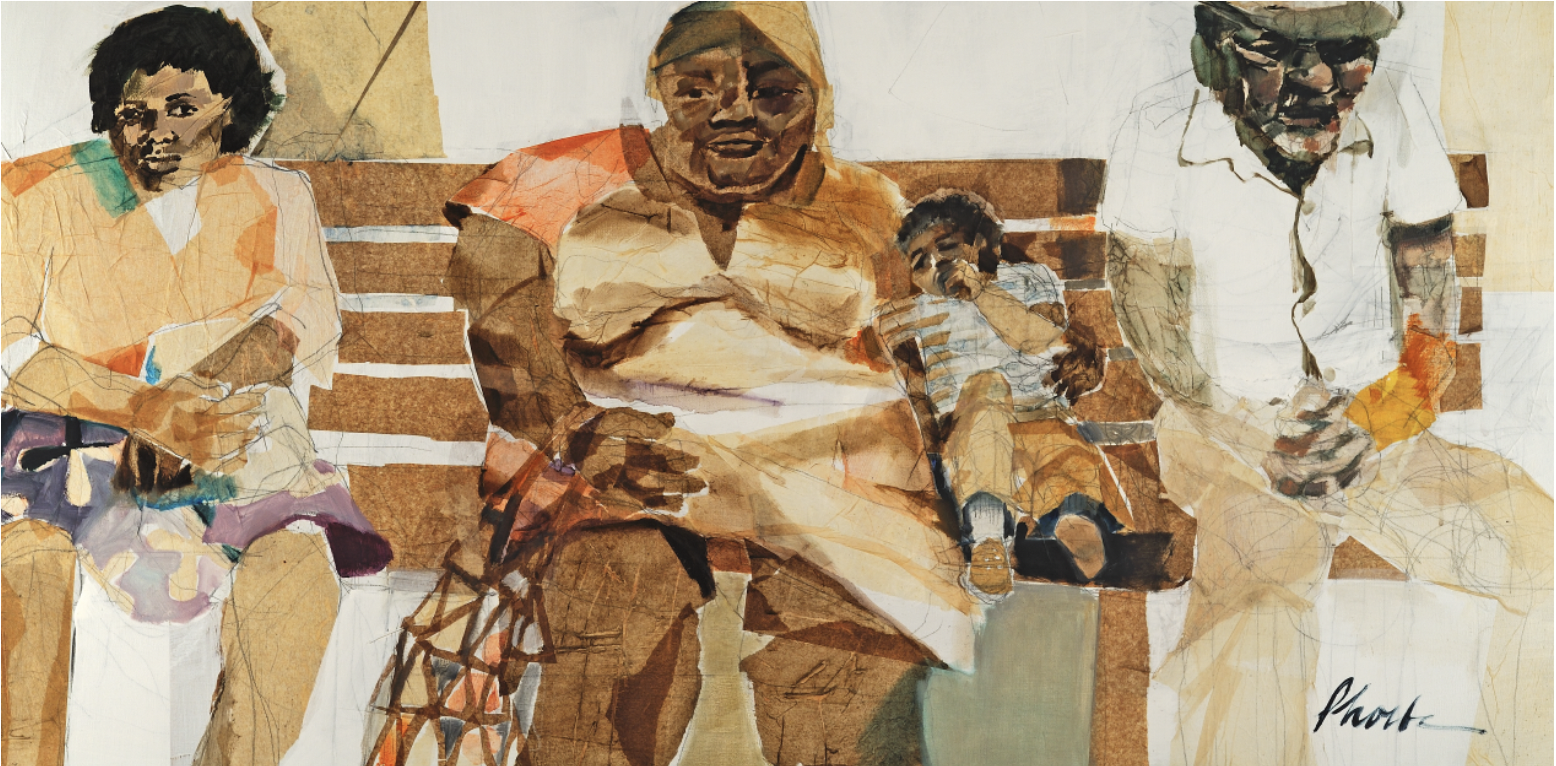
More than forty works were selected for the exhibition representing the art of thirty-one artists from the David C. Driskell Center’s Permanent Collection. The works are on display along with accompanying letters both handwritten and typed. Emma Amos (1937-2020)
Phoebe Beasley, Robert Blackburn, Lillian Thomas Burwell, Milton Bowens, Elizabeth Catlett, EKO, Ed Clark, Allan Rohan Crite, Barbara Chase-Riboud, Kevin Cole, Louis Delsarte, Meta Vaux Warrick Fuller, Herbert Gentry, Robin Holder, Manuel Hughes, Jacob Lawrence, Samella Lewis, Delita Martin, Arcmanoro Niles, Mary Lovelace O’Neal, Gordon Parks, Jefferson Pinder, Amber Robles-Gordon, Alison Saar, Augusta Savage, Frank Stewart, Renee Stout, Walter H. Williams, Richard Wyatt,
Read More"These amazing and accomplished thinkers will be engaging in a discussion about the impressive visual presentation and critical investigations present Amber’s current exhibition on view at our gallery: soveREIGNty: Acts, Forms, & Measures of Protest & Resistance."
Read MoreFEATURED
JUN 30, 2022
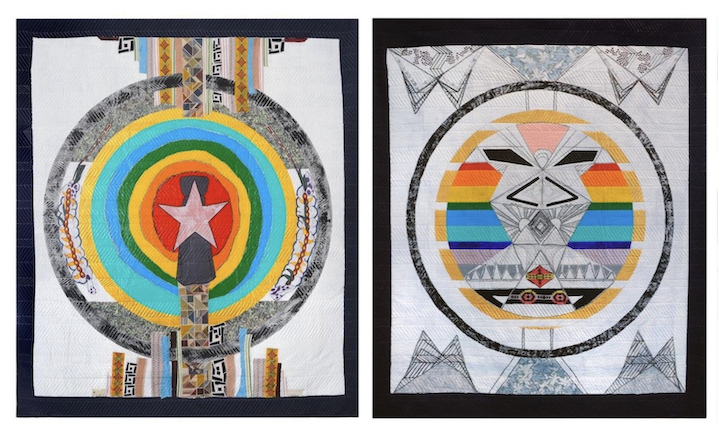
Northern Mariana Islands, Political, Spiritual,
Tinney Contemporary will be sticking with its June show through July 9. I reviewed Amber Robles-Gordon’s Sovereignty exhibition for the Scene — it’s a prime example of how artists can incorporate political and social content into a body of work while also making art that’s formally striking. We’ve seen lots of messaging about social and political issues in the contemporary art of the 21st century. However, much of that work will never be remembered or reconsidered — timely art is rarely timeless. Robles-Gordon’s work is visually successful irrespective of its critiques of the U.S. policy toward — and governance of — its populated territories and the District of Columbia. I’ve seen powerful political art and dim political art, and I often question whether visual art is an effective medium for political messages. But the work in Sovereignty is formally distinctive. Tinney Contemporary will be open this Saturday from 2 to 8 p.m.
https://www.nashvillescene.com/arts_culture/visualart/crawl-space-july-2022/article_4d18f0c8-f6e7-11ec-a1b5-8f437edaf809.html

-
THESE AMAZING AND ACCOMPLISHED THINKERS WILL BE ENGAGING IN A DISCUSSION ABOUT THE IMPRESSIVE VISUAL PRESENTATION AND CRITICAL INVESTIGATIONS PRESENT IN AMBER’S CURRENT EXHIBITION ON VIEW AT OUR GALLERY, SOVEREIGNTY: ACTS, FORMS, & MEASURES OF PROTEST & RESISTANCE
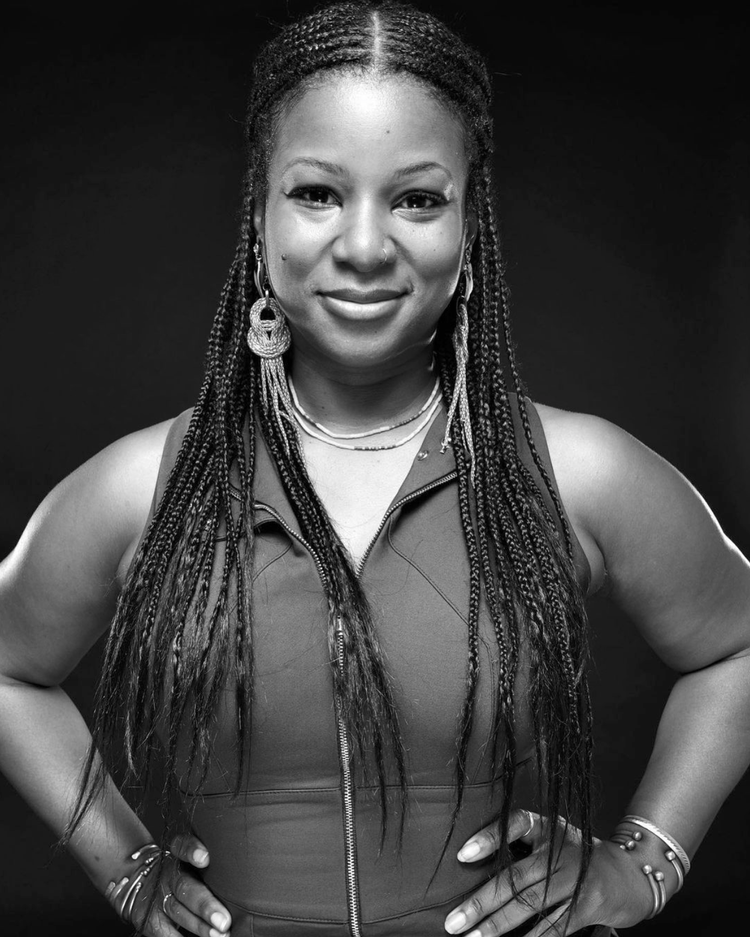
AMBER ROBLES-GORDON lives and works in Washington, D.C., and is a key advocate and participant in the arts community there. She is a member of the Delusions of Grandeur Artist Collective and Black Artists DC (BADC). Her artwork has been exhibited extensively nationally and internationally.
Most recently, her work has been featured in exhibitions at Galleria de Arte, Universidad del Sagrado Corazón, (Sacred Heart University), in her birthplace of San Juan, Puerto Rico, (PR), by Tafeta Gallery in 1-54 Contemporary African Art Fair in London, England, American University, Katzen Art Center, by the Royal Academy of Arts Sumer Exhibition in London, England, and more.
She has created numerous site-specific commissions, including a public installation with the D.C. Creates Public Arts Program. Her work has been extensively covered in publications such as The Washington Post, Hyperallergic, Art Daily, Puerto Rico Black Art Blog, Bmore Art, Culture Type, and more. She has been selected for various teaching residencies internationally, including the Centro Cultural Costarricense-Norteamericano, in Limon, Costa Rica, and Washington Projects for the Arts and DC Public Schools.
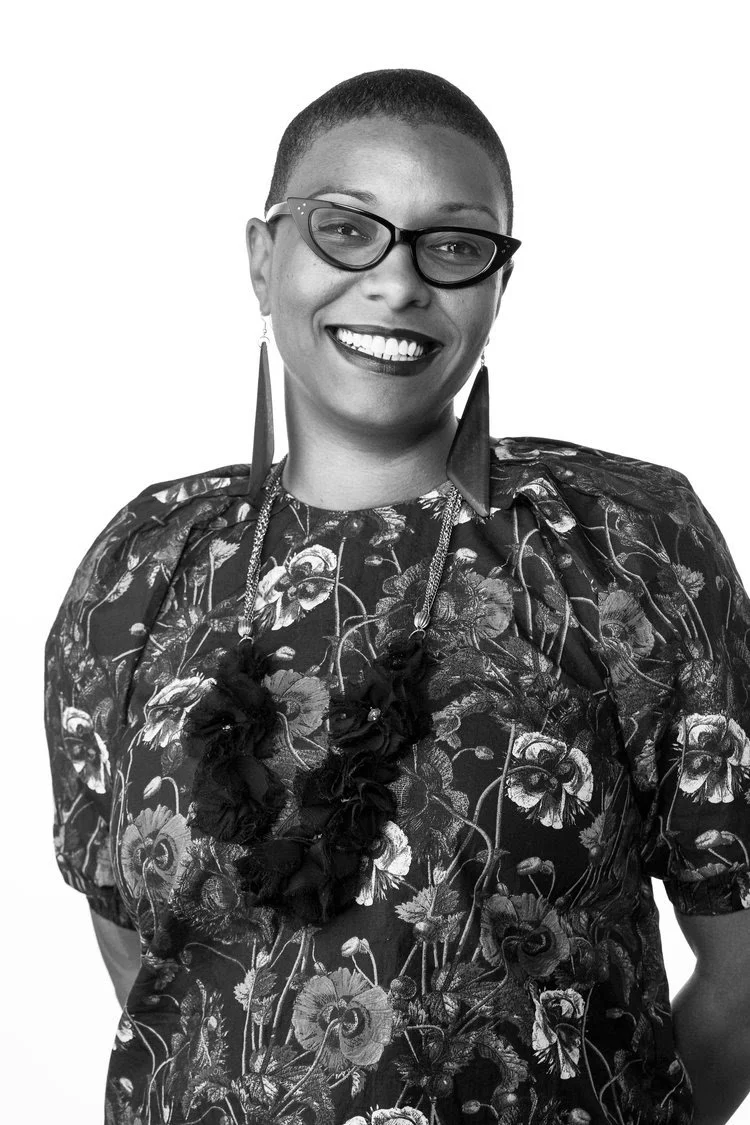
DR. KELLI MORGAN is a Professor of the Practice and the inaugural Director of Curatorial Studies at Tufts University. A curator, educator, and social justice activist who specializes in American art and visual culture, her scholarly commitment to the investigation of anti-blackness within those fields has demonstrated how traditional art history and museum practice work specifically to uphold white supremacy.
Besides her own curatorial experience, she mentors emerging curators and regularly trains staff at various museums to foster anti-racist approaches in collection building, exhibitions, community engagement, and fundraising. Over the past year, Dr. Morgan has become a leading and influential voice in bolstering anti-racist work in art museums. She has held curatorial positions at the Indianapolis Museum of Art at Newfields, the Birmingham Museum of Art, and the Pennsylvania Academy of the Fine Arts and teaching positions at Wayne State University, the University of Michigan, and the Tyler School of Art at Temple University
She earned her Ph.D. in Afro-American studies and a graduate certificate in public history–museum studies from the University of Massachusetts Amherst in 2017
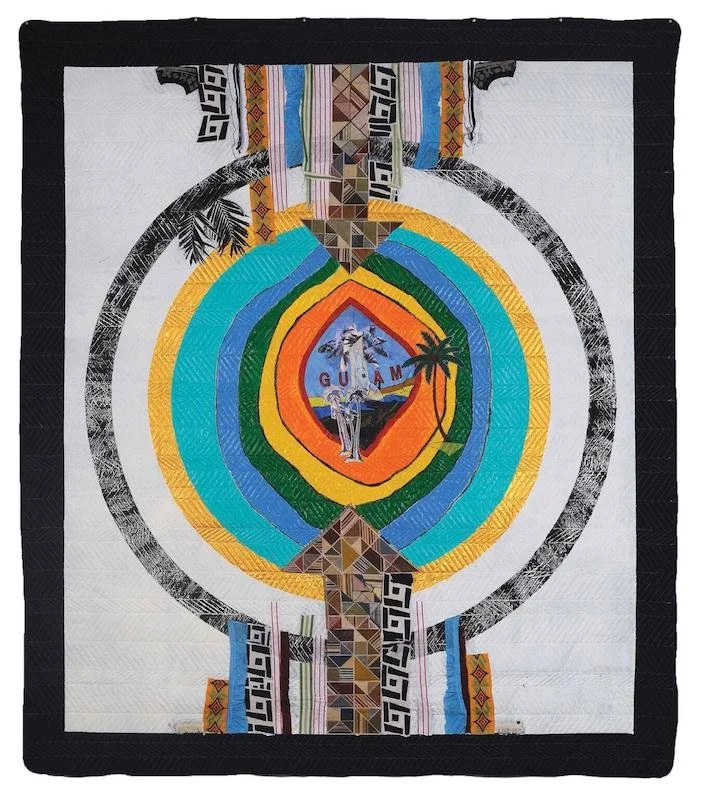
“Guam Political,” Amber Robles-Gordon
By JOE NOLAN / JUN 15, 2022
Tracking art-world trends often means simply noting the shifting balance between form and content over time. Midcentury American painting was formalist, elemental art for art’s sake. It was interested in line, shape, space, form, tone, texture, pattern, color and composition. An important work of art was something, but nowadays an important work of art is oftenaboutsomething: politics, social causes, various identity expressions.
Midcentury art favored abstraction over figuration, but contemporary art is full of figures along with the narrative content they inevitably inspire. Luckily, no matter how the trends swing, we can always look back to the Greeks and remember that there is beauty in balance. And it’s not surprising that some of today’s best art manages to message and signal and narrate after first capturing the eye, drawing attention, and igniting the imagination of the viewer.
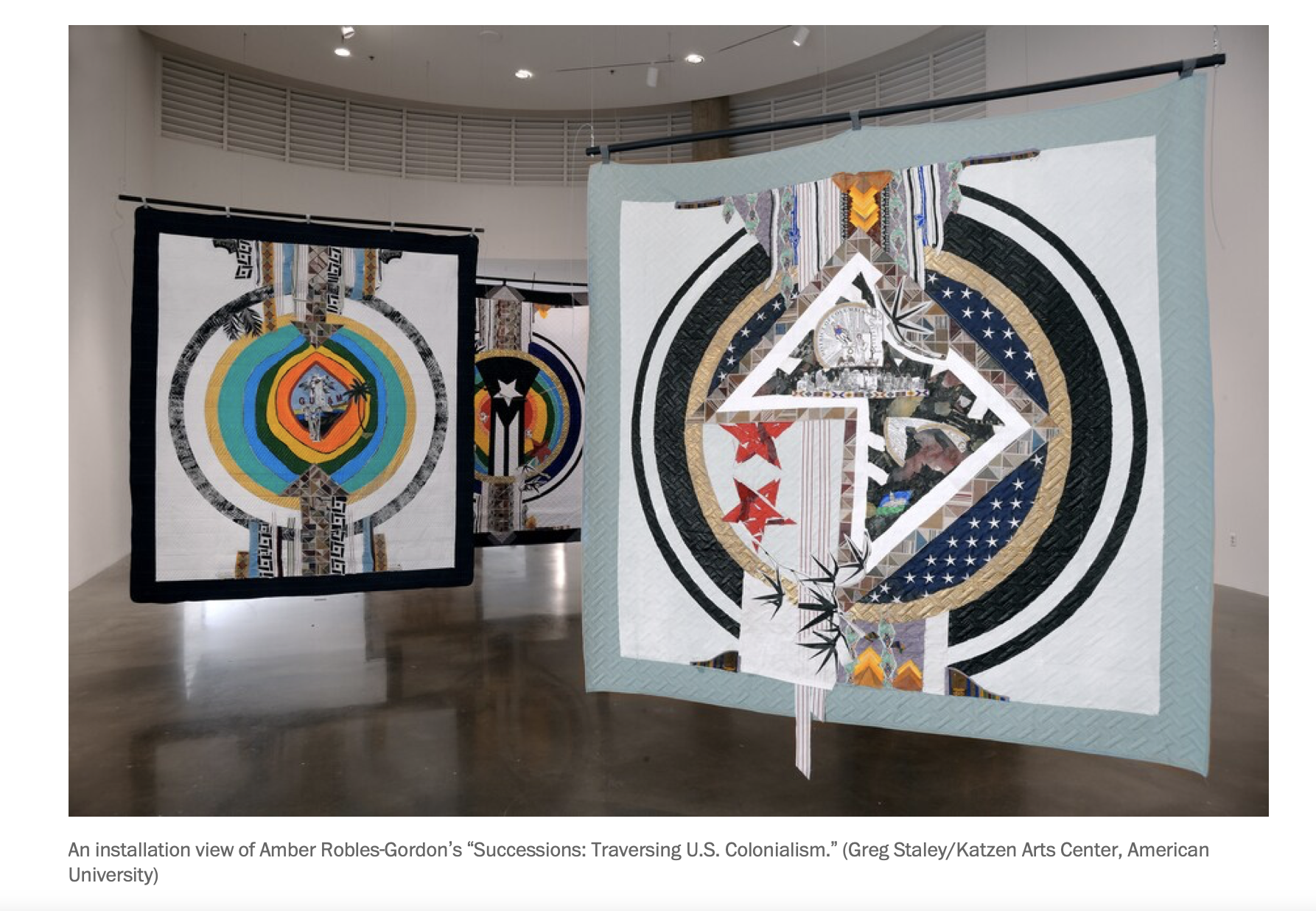
Even the title of Amber Robles-Gordon’s Tinney Contemporary exhibition — SoveREIGNty: Acts, Forms, and Measures of Protest and Resistance — expresses an activist message. And it’s emblematic of a display of large-scale, mixed-media quilts brimming with signals and symbolism interrogating U.S. policy toward — and governance of — its populated territories and the District of Columbia…

Even the title of Amber Robles-Gordon’s Tinney Contemporary exhibition — SoveREIGNty: Acts, Forms, and Measures of Protest and Resistance — expresses an activist message. And it’s emblematic of a display of large-scale, mixed-media quilts brimming with signals and symbolism interrogating U.S. policy toward — and governance of — its populated territories and the District of Columbia.
Read More
This exhibition features Amber Robles-Gordon’s large-scale, mixed-media quilts–assemblages incorporating paint, textiles and hand-stitching–in an interrogation of U.S. policy towards–and governance of–its populated territories and the District of Columbia.
Read More
On November 13, 2021 the Millennium Arts Salon provided a salon talk featuring Artist Amber Robles-Gordon in an interview with Interim Chief Curator of the National Museum of African American History and Culture, Dr. Tuliza Fleming, at the American University Museum.
Greetings,
Please consider supporting this project! THE BEAUTIFUL: Poets Reimagine a Nation. THE BEAUTIFUL features the nation's' foremost poets and revolutionizes our ideas of beauty and belonging. I'm so pleased that DanaTeen Lomax choose my artwork "By Intricate Design" as the cover art.
Blessings!
Invite beauty in!
In the chaos of a constantly shifting world, we can turn to the poets. They invite us to re-envision beauty and challenge conventional ideals. They ask us to co-create just and equitable communities. And they show us how. This multicultural, multi-generational anthology redefines beauty in order to sustain and protect it.
In THE BEAUTIFUL, truth-telling, mentorship, activism, art-making, and sustainability practices inspire communal responsibility and help us reimagine beauty in surprising ways.
THE BEAUTIFUL contributors include:
Introduction Juan Felipe Herrera
Editor’s Note Dana Teen Lomax
Sāmoa ‘i Sasa’e/American Samoa
Dan Taulapapa McMullin
Guåhan/Guam Evelyn San Miguel Flores
Northern Mariana Islands
Joey “Pepe Batbon” Connolly
Puerto Rico Julio César Pol
U.S. Virgin Islands Tiphanie Yanique
Alabama Jacqueline Allen Trimble
Alaska X’unei Lance Twitchell
Arizona Felicia Zamora
Arkansas Dana Teen Lomax
California Jaime Cortez
Colorado Jovan Mays
Connecticut Rayon Lennon
Delaware Gemelle John
Florida Nicole Brodsky
Georgia Jericho Brown
Hawai‘i No‘u Revilla
Idaho Janet Holmes
Illinois Sarah Rosenthal
Indiana Marianne Boruch
Iowa Akwi Nji
Kansas Megan Kaminski
Kentucky Kristen Renee Miller
Louisiana Megan Burns
Maine Stuart Kestenbaum
Maryland Linda Pastan
Massachusetts Eileen Myles
Michigan Rob Halpern
Minnesota 신 선 영 Sun Yung Shin
Mississippi E. Ethelbert Miller
Missouri Dorothea Lasky
Montana Prageeta Sharma
Nebraska Matt Mason
Nevada Vogue Robinson
New Hampshire Kate Greenstreet
New Jersey Cortney Lamar Charleston
New Mexico Arthur Sze
New York Jennifer Firestone
North Carolina Dorianne Laux
North Dakota Denise K. Lajimodiere
Ohio Amit Majmudar
Oklahoma Joy Harjo
Oregon Douglas Manuel
Pennsylvania Raquel Salas Rivera
Rhode Island Sawako Nakayasu
South Carolina Marcus Amaker
South Dakota Lee Ann Roripaugh
Tennessee Ama Codjoe
Texas Ching-In Chen
Utah Craig Dworkin
Vermont Camille Guthrie
Virginia giovanni singleton
Washington Sally and Sam Green
Washington, D.C. Sarah Anne Cox
West Virginia Marc Harshman
Wisconsin Oliver Baez Bendorf
Wyoming David Romtvedt
Cover Art by Amber Robles-Gordon
Book Design by Roberta Morris
Gualala Arts is a Mendocino-based nonprofit whose mission is to promote interest and participation in the arts. Since 1961, Gualala Arts has served Sonoma and Mendocino County coastal residents and visitors with year-round programs of art, music, theater and education. Gualala Arts operates with 12 members on the board of directors, an executive director and management team including: events, office, operations, project and publicity. Gualala Arts is also supported hundreds of dedicated volunteers.
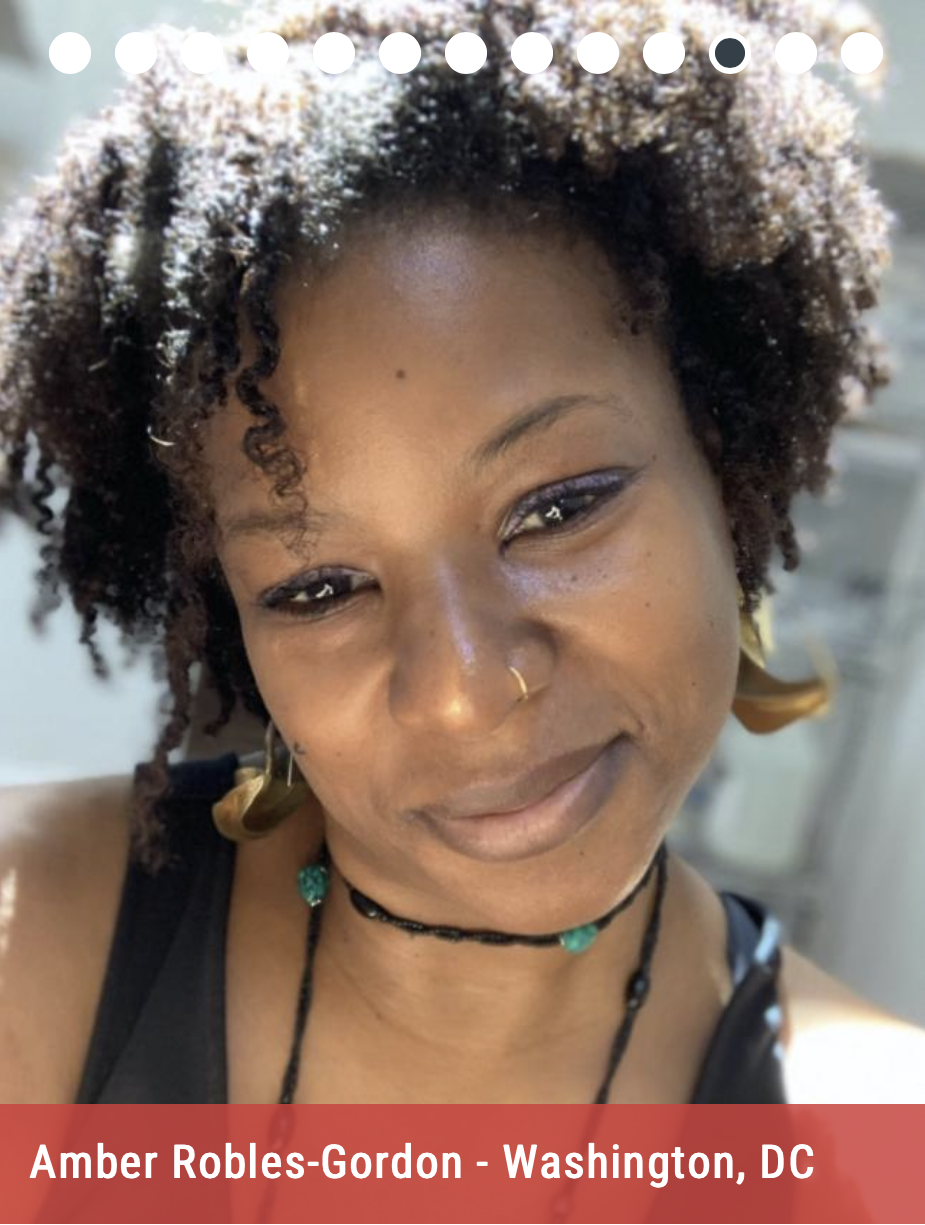
The Baltimore Office of Promotion & The Arts (BOPA) proudly announces the semifinalists for the 17th annual Janet & Walter Sondheim Art Prize. This year’s panel of esteemed jurors — Catherine Morris, Jean Shin, and Kambui Olujimi — have selected 13 visual artists for the semifinal round. Semifinalists will be asked to share an expanded submission including up to 30 images or time-based works and a description of how they will use the fellowship if they are selected
Three of these semifinalists will then be selected for final review for the prize and their work will be exhibited in the Walters Art Museum beginning in July 2022. This year, the prestigious prize will award $30,000 to a visual artist or visual artist collaborators living and working in the Baltimore region. BOPA will also be awarding two residencies to finalists not selected for the Sondheim Art Prize: a six-week, fully funded residency at Civitella Ranieri in the Umbria region of Italy, and a six-month residency at the Bromo Seltzer Arts Tower in Baltimore.
Civitella Ranieri (www.civitella.org) is a residency program for international writers, composers, and visual artists. Since 1995, Civitella has hosted more than 1,000 Fellows and Director’s Guests. The Center enables its Fellows to pursue their work and to exchange ideas in a unique and inspiring setting. The Bromo Seltzer Arts Tower has been transformed into studio spaces for visual and literary artists. Located at 21 S. Eutaw Street in the heart of the Bromo Arts & Entertainment District, the 15-story city landmark is the ideal location for artists to explore their practice.
The 2022 Janet & Walter Sondheim Prize Semifinalists:
Tommy Bobo - Washington, DC
Marybeth Chew - Baltimore, MD
Susan Crawford - Baltimore, MD
Andrew Gray - Baltimore, MD
Maren Henson - Baltimore, MD
Megan Koeppel - Baltimore, MD
Travis Levasseur - Baltimore, MD
Katherine Mann - Washington, DC
David Page - Baltimore, MD
Mojdeh Rezaeipour - Washington, DC
Amber Robles-Gordon - Washington, DC
Katiana Weems - Baltimore, MD
James Williams II - Baltimore, MD
The finalists' exhibition will be on view at the Walters Art Museum, 600 N. Charles Street, beginning in July. Admission to the exhibition is free. The day the exhibiton opens, the jurors will meet with each artist for up to 30 minutes in their exhibition space for a final interview. After the interviews, the jurors will meet and decide the prize winner and the recipient of each residency. The awards will be announced later that evening at the award reception.
In the case of COVID-19 restrictions not allowing for in-person exhibitions, BOPA will utilize the online platform Kunstmatrix, with assistance from the Walters' curatorial staff. Juror interviews will take place online, and BOPA will coordinate a virtual award ceremony.
The 17th annual Janet & Walter Sondheim Art Prize is produced by the Baltimore Office of Promotion & The Arts in partnership with the Walters Art Museum. Learn more about the Janet & Walter Sondheim Art Prize at www.promotionandarts.org. To see artwork samples of this year’s semifinalists, follow BOPA on Instagram, Facebook, and Twitter: @promoandarts
For artists who are applying for the ARG, and to promote understanding on general elements of a contract, BOPA has engaged Maryland Volunteer Lawyers for the Arts (MDVLA) to lead a virtual legal workshop training on contract law basics. The workshop, held on Saturday, March 5, from 10:00 a.m.–12:00 p.m., is free to attend. Register to get the link below.
https://www.promotionandarts.org/arts-council/janet-walter-sondheim-art-prize
Date: February 17, 2022
Time: 2:00 pm—3:30 pm
Location: Paul Robeson Gallery Workshop B
Sarah Stefana Smith – Mount Holyoke College
Moderator
Alex Callendar
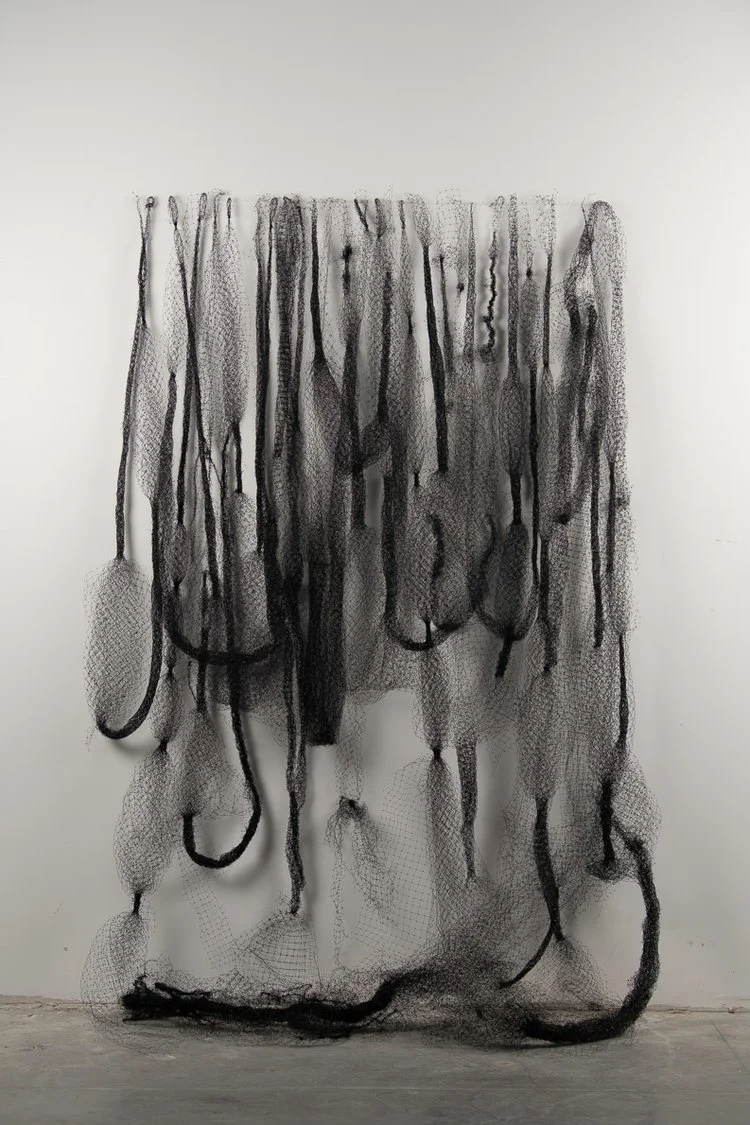
This panel is devised around the work of Carribeanist scholars and thinkers, Edouard Glissant and Sylvia Wynter. Both articulate a desire to conceive of other worlds through a reconsideration of diasporic time, space and territory, and the opacities of history. Or, as artists we ask through their theoretical frames; how do you mark a territory to something that is a void, or an abyss, or unspeakable, or mistaken as a thing? Through studio practices, which include mixed-media, drawing, time-based works and performance, we consider in an open sense, historical recovery as sites of intervention, provisionality, and play, holding space for the language of transparency and opacity emergent in Black aesthetics.
The roundtable puts to use this year’s convening of Black Portraiture and the capaciousness of play. Play then, to use the words of Stuart Hall, becomes a mode to consider Black diaspora being, refusal and resistance with no guarantee. Hall notes on play with no guarantee,
“Far from being eternally fixed in some essentialized past, they are subject to the continuous “play” of history, culture and power. Far from being grounded in mere “recovery” of the past, which is waiting to be found, and which when found, will secure our sense of ourselves into eternity, identities are the names we give to the different ways we are positioned by, and position ourselves within, the narratives of the past” (Hall 2000, 23).
Thus, we conceive of this roundtable on play with no guarantee in manifold ways. Some negotiate historical counternarratives through the afterlife of the archive, while others meditate on materiality and matter as psychic scaffolding and memory work.
Bios
Alex Callender’s practice uses methods of drawing, painting, and installation to trace and remap historical materials as a means to explore with both criticality and care, how we might disentangle the interwoven relations of race, gender, and capitalism. Callender is an Assistant Professor of Art at Smith College.
Amber Robles-Gordon, is a mixed media visual artist. Her creations are visual representations of her hybridism: a fusion of her gender, ethnicity, cultural, and social experiences. Known for recontextualizing non-traditional materials, her assemblages, sculptures, installations emphasize the essentialness of spirituality and temporality within life. Robles-Gordon, received a Bachelor of Science, Business Administration from Trinity University, and a MFA from Howard University.
Nyugen E. Smith (USA, Haiti, Trinidad and Tobago) is a first-generation Caribbean-American interdisciplinary artist based in Jersey City, NJ. Through performance, found object sculpture, mixed media drawing, painting, video, photo and writing, Nyugen deepens his knowledge of historical and present-day conditions of Black African descendants in the diaspora. He holds a BA, Fine Art from Seton Hall University and an MFA from The School of the Art Institute of Chicago.
Sarah Stefana Smith is an interdisciplinary scholar and visual artist. Their sculpture and installation work explores the intersection of repair and disrepair. Their research communicates between the fields of Black art and culture, queer theory and affect studies, visuality and aesthetics. Smith is an Assistant Professor of Gender Studies at Mount Holyoke College.
https://www.blackportraitures.info/bp7/event/marking-territory-in-the-void/

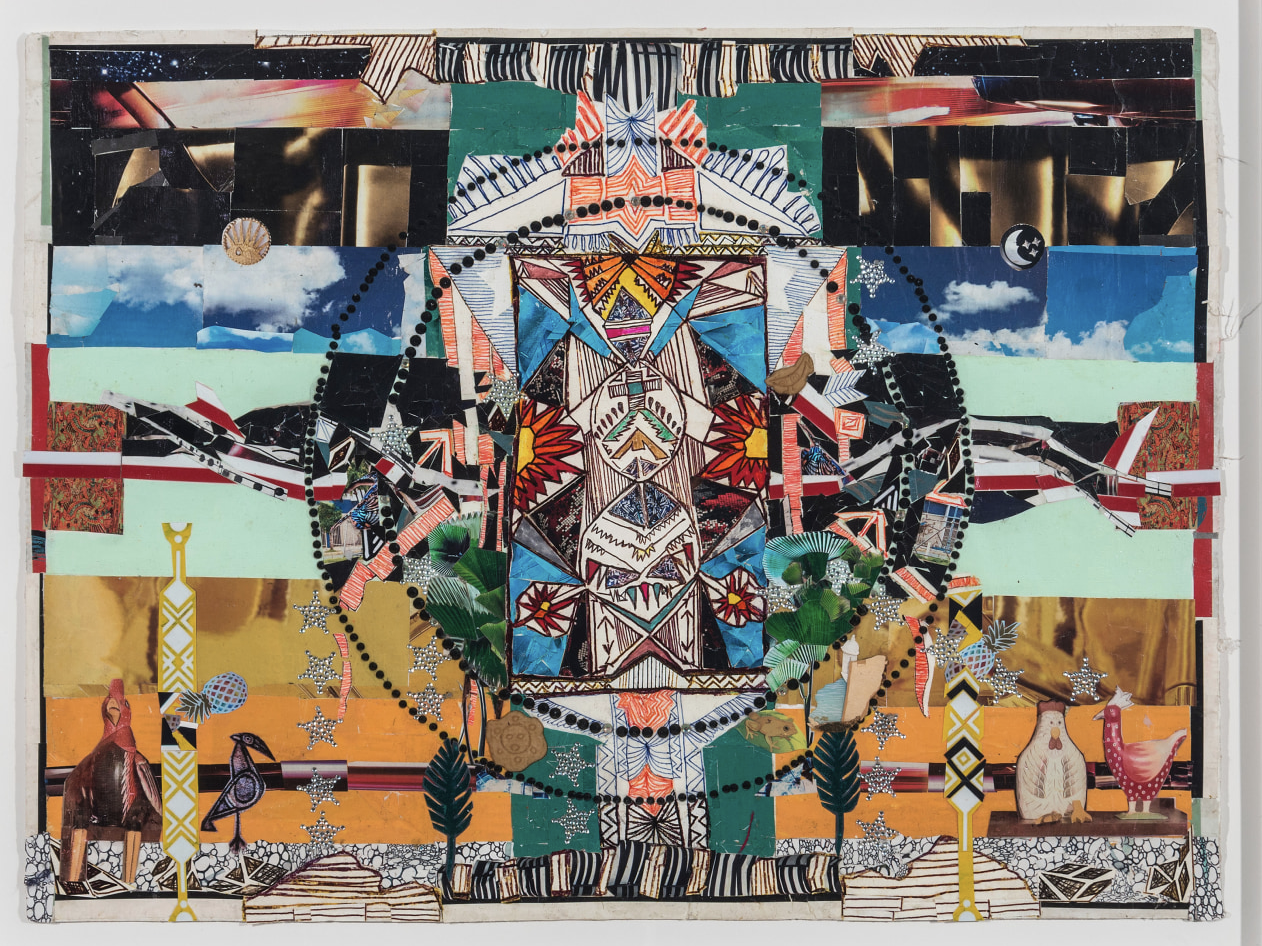
Obervacion de Influentes cultura y herencia Taino, el clima y el machismo (Observation of Influencers: Taino culture and heritage, the climate and machismo), 2020
mixed media collage on canvas
18 x 24 in.
Desde el 6 de enero y hasta el 5 de febrero de 2022, la Derek Eller Gallery presenta dos exposiciones individuales de las artistas Jiha Moon y Amber Robles-Gordon.
Fuente: Derek Eller Gallery. Imagen: Amber Robles-Gordon, “Observación de Influencers: cultura y herencia Taino, el clima y el machismo” (Observation of Influencers: Taino culture and heritage, the climate and machismo), 2020
Nacida en Puerto Rico en 1977, pero criada en los suburbios de Washington DC, la herencia caribeña siempre ha estado presenta en la obra de Amber Robles-Gordon. Utilizando una amplia gama de materiales -incluyendo pintura acrílica, fotografía, tela y el dibujo a tinta- Robles-Gordon rinde homenaje a los temas tradicionales puertorriqueños a la vez que denuncia la relación colonialista entre Estados Unidos y Puerto Rico. La galería explica como el árbol del caucho (Fiscus Elastica, planta autóctona de Puerto Rico) es un tema recurrente en las obras expuestas en “Place of Birth and Breath” (Lugar de nacimiento y respiración), estando a veces rodeada “de ‘ecoesferas’ circulares, densamente repletas de información y artefactos relacionados con su conexión espiritual y etérea con su entorno.”
Al mismo tiempo, la galería presenta también Jiha Moon: Stranger Yellow, una exposición de obras de la artista Jiha Moon, nacida en Corea del Sur en 1973 pero residente en Atlanta. El título de la exposición hace referencia a un tono particular de amarillo empleado por la artista en sus obras, que Moon describe como “un color misterioso, exuberante, pero cautelosamente alto, que destaca”. La pieza central de la exposición, “Yellowave (Stranger Yellow)”, un díptico de unos tres metros de largo, muestra varios de los elementos habituales en la obra de la artista, desde el uso del “Stranger Yellow” hasta la presencia de elementos del folklore y la cultura popular coreana.
Ambas exposiciones pueden contemplarse en la Galería Derek Eller de Broome Street, Nueva York, de martes a sábado de 11 a 18 horas, y con cita previa.
https://theartwolf.com/es/exposiciones/jiha-moon-robles-gordon-eller-2022/

Derek Eller Gallery is pleased to present a solo exhibition of mixed media works on canvas by Amber Robles-Gordon. With an array of materials including acrylic paint, fabric, beads, magazine images, photographs, and ink drawings, Robles-Gordon assembles patchwork compositions which interweave her personal narrative within the fraught political, socioeconomic, and environmental threads that define the colonialist relationship between the United States and Puerto Rico.
Read More


“y mi bandera vuela mas alto que la tuya,” 2020. Mixed media collage on canvas, 18 x 24 in. Courtesy of the artist.
By Andrea KirshDecember 17, 2021
An artist’s visit to her mother’s birth place in Puerto Rico awakens her to the complexities of immigration and family – and to the dubious socio-political actions and inactions, by the U.S. government in its far-flung territories. Our reviewer Andrea Kirsh is moved by the powerful collage works and double-sided quilts of Amber Robles-Gordon. The show closed Dec. 12.
Amber Robles-Gordon‘s first grade classmates in Arlington, VA bullied her for speaking Spanish, so she learned to speak to her mother in English. It wouldn’t be until middle age that the artist finally visited her mother’s birthplace in Puerto Rico. Successions: Traversing U.S. Colonialism, her solo exhibition at the the American University Museum at the Katzen Center (August 28 – Dec. 12, 2021) in Washington, D.C. was the product of that initial trip and a her return for a six-week residence on the island in 2020.
The exhibition presented two bodies of work. The first, “Place of Breath and Birth” is a series of ten vibrant collages on canvas, all 18 x 24 inches; two, represented by full-scale pigment prints. The collages are constructed from masses of tiny images cut from paper; even the bands of color that form their backgrounds are assembled from minute, colored fragments. And there is a very personal rhythm – like distinctive brushwork – in the way Robles-Gordon arranges the fragments.
Another personal language of Robles-Gordon’s appearing in the fragments is inspired by multiple, non-Western cultural traditions and imagery taken from magazines and photographs. These fragments are used as structuring and framing elements, incorporating the artist’s drawings of detailed and decorative, spiky, geometric patterns. An occasional small trinket or charm adds surface texture, as does the profusion of tiny, sparkly beads which outline the central, circular forms on each collage. The beads and high-keyed colors capture the intense sunlight of the Caribbean and lend a festival-like quality to the series.
Robles-Gordon culls her imagery from photographs she took in Puerto Rico or found elsewhere that evoke its lush, intensely-polychromed environment – both natural and human. While on the island, she was fascinated by the rubber trees and palms, the coconuts and mangos, street murals and public art. The titles of individual collages suggest the range of topics that were prompted by her visits: “Observation of Influencers: Taino culture and heritage, the climate and machismo,” “For bioluminescent bays and turtles.”
Her long-time interest in spirituality and syncretic, New World religious practices inspire aspects of the collages’ format, which the artist likens to personal altars. The imagery of fruit and floral offerings, flickering candles and the crystalline forms of her drawing run throughout the series and reinforce their spiritual associations. She includes photos of herself – both earlier and contemporary images – in several collages, and there is no question that the series itself is a diary of self-discovery.
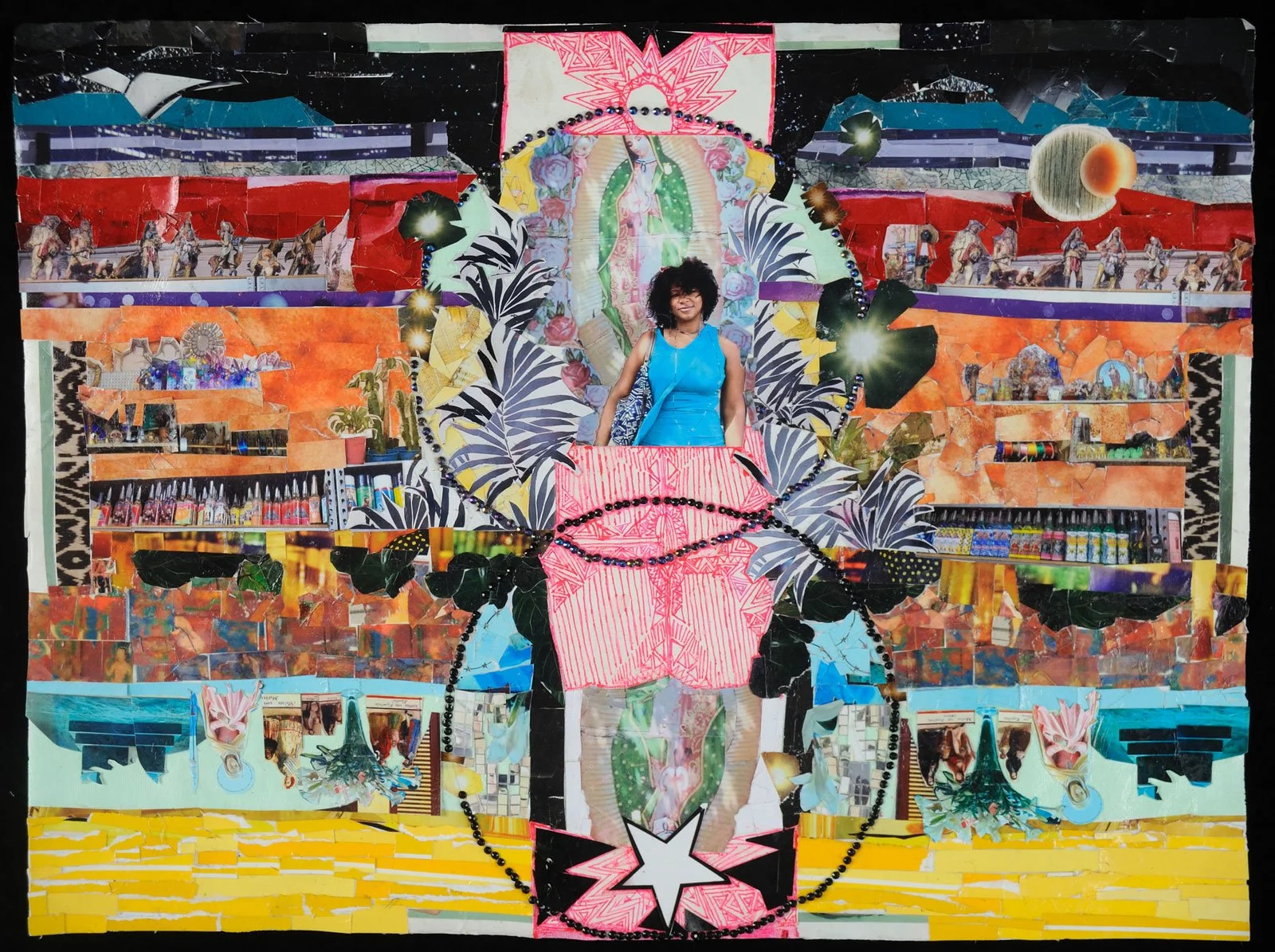
“Reflexiones sobre el yo, la virgen maría y el colonialismo,” 2020. Mixed media, collage on canvas, 18 x 24 in. Courtesy of the artist.
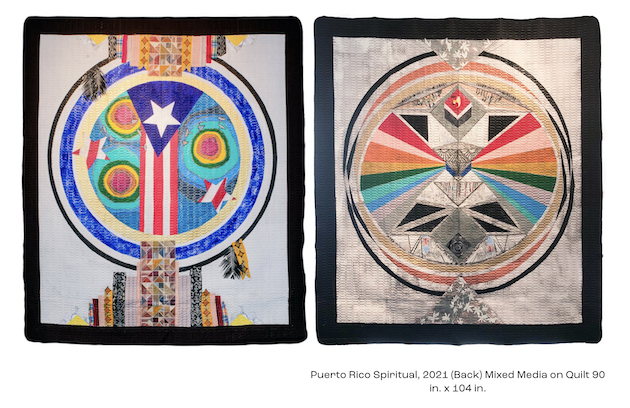
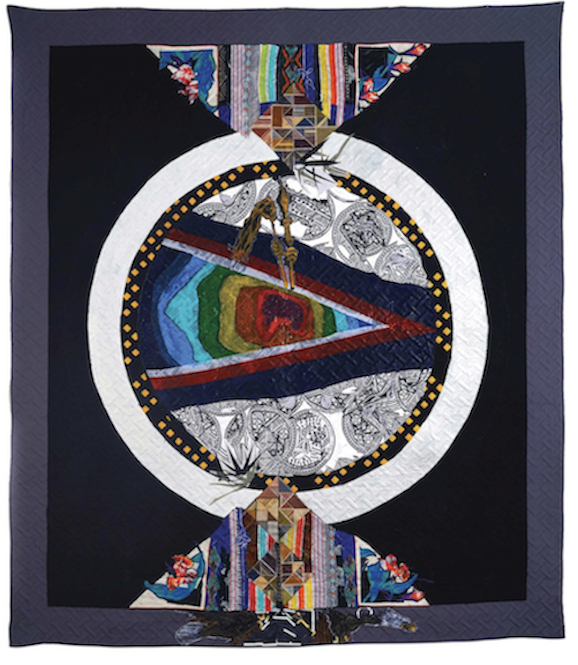
If the collages capture Robles-Gordon’s connection to her ancestral culture in the form of personal, spiritual reflection, the second part of the exhibition responded to her developing political understanding of Puerto Rico’s position as a U.S. Territory. The works are a public forum in which to teach, to encourage discussion, to heal, and to begin building a congregation of territorial residents. Six, large, double sided, appliqued quilts hung throughout the high-ceilinged gallery. The installation, which gave its name to the exhibition, was titled “Successions; Traversing U.S. Colonialism.” The quilts include dense references to histories that have yet to be acknowledged and the dark underside of U.S. power. Their format entangles the conventionalized emblems of history and patriotism with the domestic craft of quilting, the masculine pursuit of territory and power with a feminine tradition of healing.
On one side of each quilt Robles-Gordon addresses political history, with references to each of the U.S. Territory’s flag or seal, as well as to the exploitation of its indigenous people for medical experimentation, military support and economic interests; on the other side she constructs an altar dedicated to healing the damage of historical exploitation and the racism which underpins it. Both sides bear central medallions; they are greatly enlarged versions of the circles in the collages, and make references to the circle as a foundational religious image and form of celebration – to healing circles and ceremonial dancing. The healing altars are constructed with the same spiky, geometric patterning that Robles-Gordon used in the collages, and all have hieratic, symmetrical designs. Here they suggest abstracted figures of deities, and their patterning makes reference to a variety of Afro-diasporic and non-Western decorative histories seen in painting, textiles and ceramics. Although painted, they appear to be drawings in chalk on black backgrounds, which suggests religious images in various cultures which are intended to be temporary.
The timing of Robles-Gordon’s residency in Puerto Rico reinforced her understanding of the disparity between U.S. government support to the island after the overwhelming damage from Hurricanes Maria and Irma in 2017, and the level of disaster relief Americans have come to expect on the mainland. This understanding, in turn, led to her interest in the U.S. Territories as a group; areas under United States dominion with the highest percentage of poverty, where the government has exploited resources and sited strategic military bases, with little concern for the inhabitants – all people of color, who are largely, only nominally U.S. Citizens. The territories function, rather, as U.S. colonies.
Puerto Rico, Guam, American Samoa, the Virgin Islands, and the Northern Mariana Islands are unfamiliar to many on the mainland United States. Few Americans know that their residents are U.S. Citizens with the right to vote – although they lack full representation in Congress. Robles-Gordon included Washington, D.C., her current home, among the territories because it’s residents, too, fall under U.S. jurisdiction but have no fully-empowered Congressional representative.
Robles-Gordon used her childhood bullying as a spur to understanding her own cultural traditions, and it is characteristic of her long-developed career of teaching and producing art that she didn’t respond to the history of territorial exploitation with rage, but with honesty, offering understanding, teaching and healing as a foundation on which to advocate for social justice in the outlying regions of the United States and in powerless communities internationally. The sense of spirituality and turning towards a better future pervades her work as much as her personally-developed language of forms and patterns, use of repurposed materials, passionate polychrome, and fusion of visual traditions.
Amber Robles-Gordon, “Successions: Traversing U.S. Colonialism” is now closed. It was on view at the American University Museum at the Katzen Center in Washington, D.C., August 28–December 12, 2021.
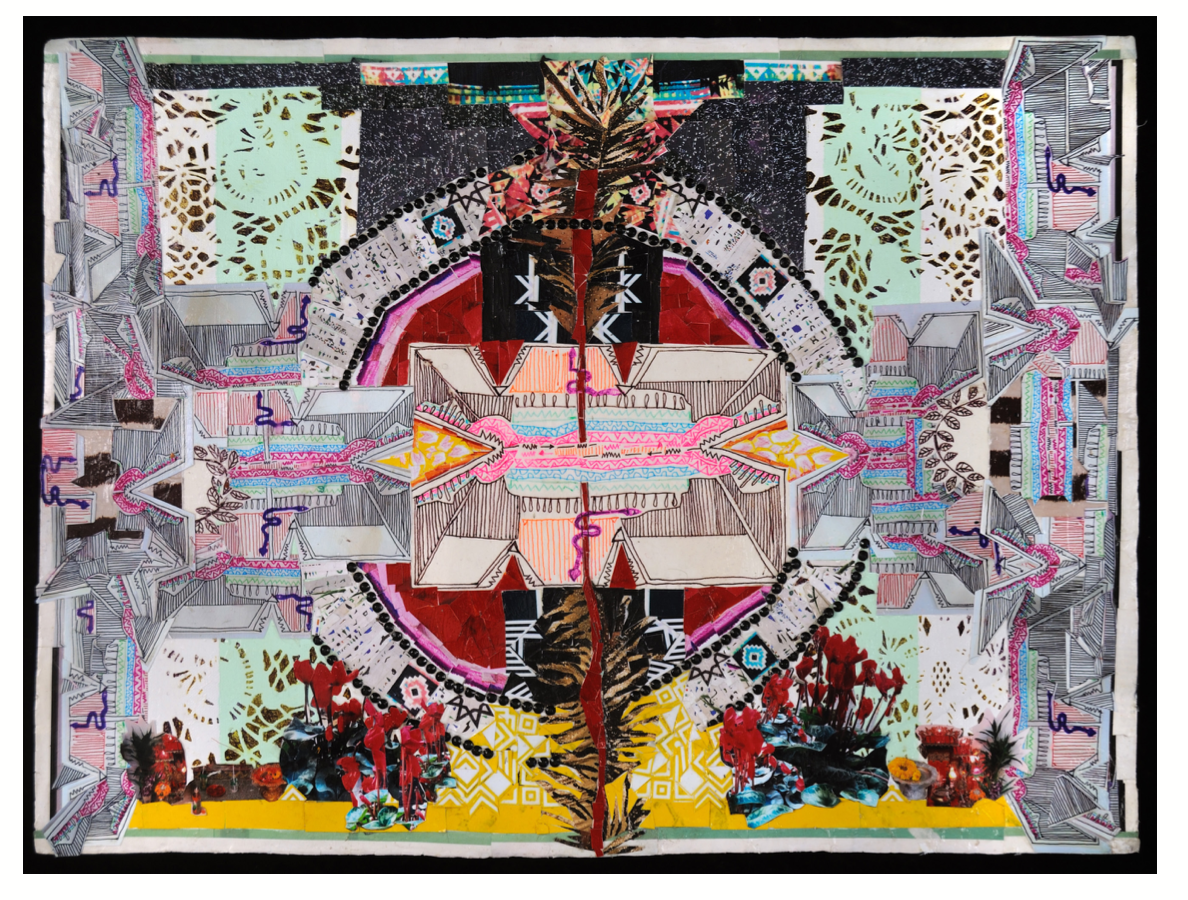
“The eternal altar for the women forsaken and souls relinquished. Yet the choice must always remain hers/ El altar eterno de las mujeres abandonadas y las almas renunciadas. Sin embargo, la elección siempre debe ser de ella.,” 2020. Mixed media collage on canvas, 18 x 24 in. Courtesy of the artist.
Washington, DC — Seven “flags” hang in Amber Robles-Gordon’s show at the American University Museum: one for each of the five unincorporated United States territories in the Caribbean, one for the District of Columbia, and one to signify the artist’s place in between those locales.
Read MorePeople, food, and horticulture are among the things that move. Amber Robles-Gordon’s use of the Ficus Elastica is part of the symbology that reverberates throughout her exhibition, Successions: Traversing US Colonialism, on view at the American University Museum at the Katzen Arts Center in Washington, DC, through December 12, 2021. The Ficus Elastica—colloquially known as the rubber tree—has its roots in South Asia, though it was later nativized in the West Indies through the rubber trade. Dear reader, among your houseplants you are likely to find the genus of the rubber plant.
Read More
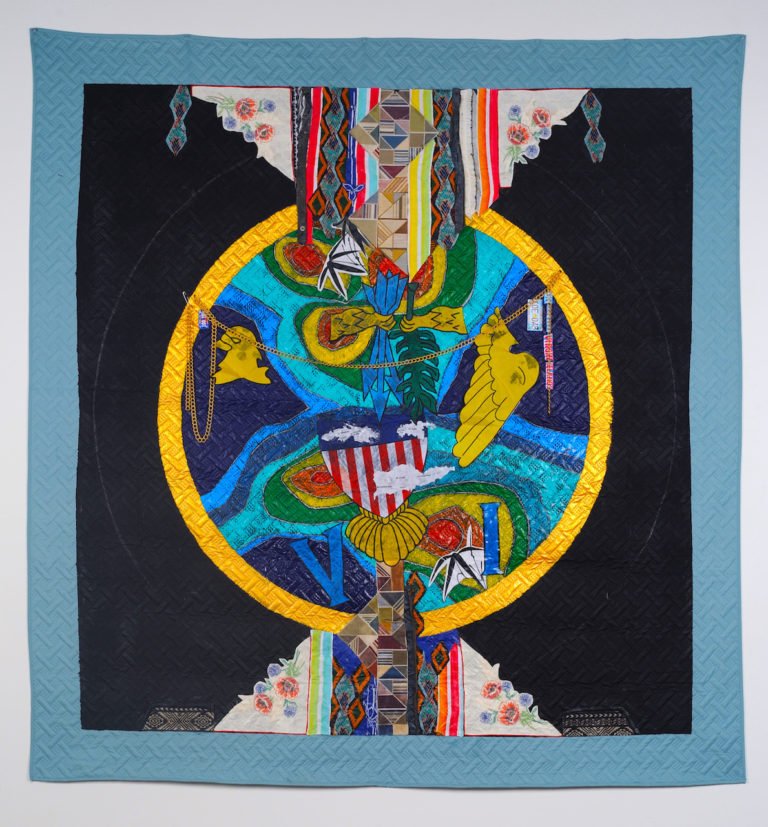
“USVI Spiritual, Moko Jumbie: Walk Tall and Heal Forward” Mixed Media on quilt, (back of “USVI Political”) 2021 (Courtesy of Amber Robles-Gordon)
Amber Robles-Gordon’s “Successions: Traversing U.S. Colonialism” has a dual purpose. It consists of her “Place of Birth and Breath” solo exhibit viewed first in her native Puerto Rico in 2020, and it has evolved into a component exhibit, which is an exploration of the historical underpinnings of U.S. Colonialism.
Robles-Gordon is a mixed media visual artist whose solo exhibit at the American University Museum opened in August and can be viewed Fridays through Sundays, from 1 p.m. to 4 p.m. until Dec. 12.
What began as a quest, “to heal my five-year-old self: to empower her to fight for herself, her language and her culture,” the exhibition took on “the intersections of language, culture, institutional racism, anti-blackness and their immeasurable impact within the U.S. territories,” said Robles-Gordon.
A native-born Puerto Rican with family from St. Thomas, St. John, Puerto Rico, Tortola and Antigua, Robles-Gordon created a visual discussion of the historical and political plight and resilience of the District of Columbia, where she resides, and the five U.S. territories that her two-sided quilts represent. They embody the artist’s creation of a political study of the territories and on the reverse side, a spiritual and cultural study.
Robles-Gordon’s early love of art and creativity moved her delight with fabrics, quilts and found objects to the discovery that these could and would be her artistic narrative.
A writer uses words to express; my medium of expression is my art, she said. “I use a myriad of materials according to what I’m trying to convey in a particular project or a particular narrative. It’s very essential that I match up with what I’m trying to convey,” Robles-Gorden said.
The decision to dismiss her native language, Spanish, came as a result of the teasing and ridicule Robles-Gordon experienced as a five-year-old kindergartener at her school in Arlington, Virginia, far away from her birthplace of Puerto Rico. She did not look like a Latina girl that was familiar to her classmates, and hence developed the bullying of this little brown-skinned girl.
In time, Robles-Gordon realized the importance of embracing her language and her culture and the need to find ways to heal through her research and employ it through her art as the medium on her journey to healing.
Speaking of her years as an artist, Robles-Gordon’s journey toward healing is what she brings creatively in her discoveries about U.S. Colonialism, “I think that it’s a beginning. There’s not an end to my journey. It’s a part of my journey. I think I’ve done a hell of a job in starting it. I actually feel proud about it in my own life. That feels good,” she said.
Robles-Gordon made the universe know how important this part of her journey is. “I think I’ve done that,” she said.
“Successions: Traversing U.S. Colonialism” exhibits the component of Robles-Gordon’s body of work containing six quilts embodying the Commonwealth of the District of Columbia, and the five U.S. territories of Guam, the U.S. Virgin Islands, Puerto Rico, the Northern Mariana Islands and American Samoa. The other component, “Place of Birth and Breath,” is the collage on canvas series created in 2020 and exhibited at the Universidad del Sagrado Corazon, (University of the Sacred Heart) in Puerto Rico.
“Place of Birth and Breath” is Robles-Gordon’s 10 mixed-media collage canvases that are a result of the visit with her mother to Puerto Rico where both women recaptured their roots, one of her childhood home, and the other of her birthplace.
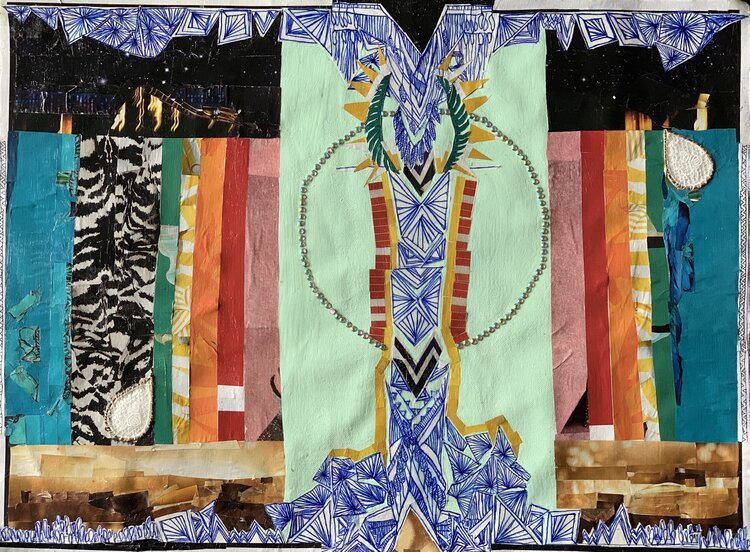
“Isla del Encanto” collage, 18×24, 2020. (Courtesy of Amber Robles-Gordon)
A foundational symbology of the “Birth and Breath” body of work is the rubber tree that grows on the campus of the University of the Sacred Heart, which Robles-Gordon was introduced to while in Puerto Rico. “This tree appeared to be a literal fusion of past, present and future states of creation or sustaining an ecosystem. Throughout the series, are abstracted representations of the rubber tree – an entanglement of strong roots – as an example of its resiliency this tree most recently stood-fast to its native soil while 155 mph winds battered the campus,” Robles-Gordon noted.
Robles-Gordon shares her intricate ideas of how she layered her work depicting and interpreting the transitions of day to night and night to day. She relates to three major ethnic/racial groups – the Taino, the Spaniards and Africans, the stranglehold of the United States and the impact of the Caribbean Sea with its threat of hurricanes, scorching summer heat and lush landscapes.
Successions: Traversing U.S. Colonialism at American University exhibition closes on Dec. 12. The journey continues. The conversation continues. The healing continues.
See Amber Robles-Gordon’s website here..
Residents of D.C. are used to seeing the place as an almost-state, much like Maryland or Wyoming, yet not quite. Amber Robles-Gordon, a longtime Washingtonian who was born in Puerto Rico, has a different take. Her American University Museum show, “Successions: Traversing U.S. Colonialism,” groups D.C. with her birthplace and four other inhabited territories: Guam, the U.S. Virgin Islands, American Samoa and the Northern Mariana Islands. She represents these disenfranchised territories on two-sided quilted banners, one face for “political” and the other for “spiritual.”
Read MoreJoin our panelists as they journey through texts by Octavia Butler and bell Hooks, Parable of the Sower and Salvation: Black People and Love. They will explore and discuss parallels and intersections between themes posited in these seminal texts and their own individual curatorial/artistic practices.
Read MoreThis panel explores the power of contemporary visual art through the practices of the Diaspora’s most preeminent artists who innovate through the use of textiles. The panel will also share how their works are impacted by black existential thought. Followed by Cocktails and Light Bites Vranken Pommery and Red Rooster.
Read More